











In global equities, the debate over valuation never disappears; it simply evolves. Over the past decade, markets have been led by a narrow group of large-cap winners, many of them technology-driven, highly cash-generative and richly priced. That has been difficult for traditional value investors, who have often waited in vain for mean reversion. Yet the central question remains: how can investors distinguish between companies that are truly expensive and those whose intrinsic value is obscured by accounting conventions?
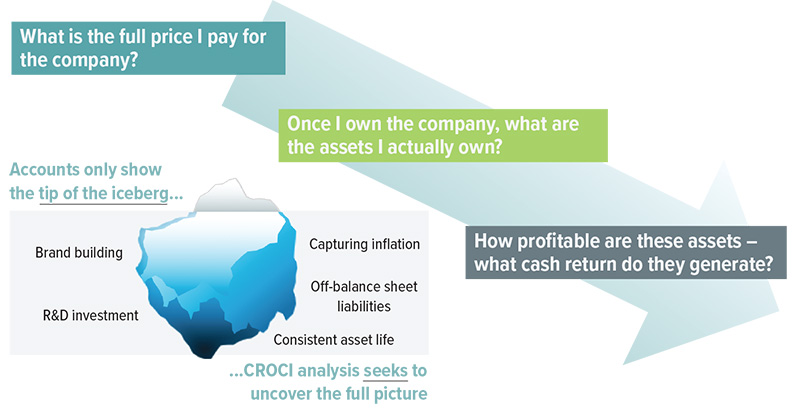
That is the space occupied by CROCI, or Cash Return on Capital Invested, a valuation framework developed in 1996 and used by DWS across a range of systematic equity strategies. Its premise is simple: reported accounts are often an imperfect guide to economic reality. Different treatments of depreciation, goodwill and capitalisation can make similar businesses look very different. CROCI aims to strip out that noise by rebuilding company accounts on a more comparable basis, seeking to show what a business is really earning relative to the capital it employs. DWS supports this work with proprietary bottom-up research covering nearly 900 companies globally, conducted by a team of more than 50 professionals.
A level-playing field
What makes CROCI especially relevant is that it does not fit the old caricature of value investing as a search for low price-to-book or low price-to-earnings ratios. Instead, it aims to create a level playing field across sectors and regions, looking for businesses that combine quality, growth and attractive valuation. DWS describes the philosophy as valuation-driven and systematic, but not purely mechanical: portfolio construction is rules-based after internal research has attempted to build a more realistic picture of economic returns. Historically, the firm says this has translated into long-term excess returns of around 2 to 4 per cent a year over more than two decades, with relatively strong downside characteristics in stressed markets.
That message may resonate particularly strongly in 2026. Investors are navigating concentration risk, questions over the durability of artificial-intelligence-led earnings optimism and broader concerns that benchmark-heavy portfolios have become overly dependent on a handful of names. In that environment, a methodology that re examines what companies are really worth may have renewed relevance. The CROCI platform has also evolved beyond broad value strategies into more targeted approaches, including dividend- and innovation-focused portfolios, suggesting the framework can be used to identify economic value more holistically than simply buying the cheapest stocks in the market.
No crystal ball
The innovation angle highlights a major weakness of conventional accounting. Companies that invest heavily in research, software, data, brands or intellectual property can look less profitable than they really are when those outlays are treated purely as expenses rather than as investments in future returns. CROCI seeks to address that mismatch by capitalising such intangible assets as invested capital, with the aim of giving a clearer view of cash generation. In an economy where intangible assets often drive corporate success, that can help investors judge whether high-growth businesses are genuinely overvalued, fairly valued or simply misunderstood.
Of course, no methodology is a crystal ball. Even the most carefully normalised data cannot eliminate market timing risk or style headwinds, particularly in periods when markets are driven more by narratives or momentum. CROCI does not guarantee short-term outperformance, but offers a more rigorous lens through which to analyse value.
For professional investors, that may be the real attraction. At a time when markets often reward simple narratives over deeper analysis, CROCI reflects the belief that fundamental work still matters. Its relevance rests on an old but powerful idea: the numbers most widely used by the market are not always the numbers that matter most. In a world shaped by passive flows, benchmark concentration and momentum, an approach that seeks to restore comparability may find a renewed audience. Whether CROCI proves the right answer will depend on performance and market conditions, but as a framework for asking better questions about value, it remains hard to ignore.
Please contact Andrea Kilby, wholesale coverage specialist, DWS, on +44 0207 547 3346 or Andrea.kilby@dws.com.