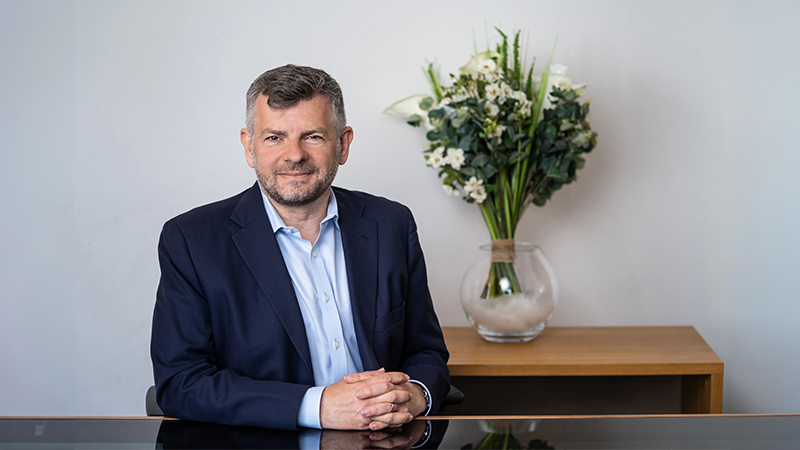







The London Stock Exchange Group’s David McNay made an existential discovery about his career in South Africa, while drinking a glass of wine and looking out at Table Mountain with his former boss. “He asked me whether, if I had to answer him immediately, I was more of a researcher or more of a portfolio manager,” he tells Portfolio Adviser at the firm’s headquarters in Paternoster Square.
“It was then I realised the thrill of being a portfolio manager, of being responsible for running a fund, had taken second place to the overall excitement of investment research. And, within the world of research, communicating these ideas to people – looking at the data, working out what it meant and then articulating this to investors.”
Following this conversation in 2023, McNay formally started wearing two hats. One as a portfolio manager, the other as head of multi-asset research at Stanlib, the institutional asset management division of Standard Bank.
“I think a lot of people see the ‘glory’ of placing trades and taking positions as a portfolio manager, but they overlook that markets are constantly moving, you’re constantly seeing subscriptions and redemptions in your portfolio.
“And, the whole time, you’re worrying about your DV01 [a risk metric which measures a portfolio’s sensitivity to interest rate changes] or your equity beta relative to where you want it to be. You’re making sure you have enough liquidity for redemptions.
“All of this seemingly ‘peripheral’ stuff, which you need to focus on to be a good portfolio manager, takes up a lot of your time. Moving into more of a research function, you get much more time to focus purely on markets.”
After five years at Stanlib, followed by three months exploring South Africa with his young family, McNay returned to the UK to take on the mantle of multi-asset research director at FTSE Russell, part of the LSEG, in September last year.
Now, he works within a global team of 10 researchers, half of whom are based in London.
“It’s such a cliché, but my days are quite varied. Having been a portfolio manager, I still wake up and immediately check what is going on in the markets and what has happened overnight internationally,” he says.
“Then, I will spend time catching up on bits of research, looking at what macro indicators might be relevant from market moves, and checking in with the team to see what everyone has been working on.”
Other day-to-day activities for the research director, alongside writing reports, include editorial checks, client meetings and events, and public speaking.
Shining a light on blindspots
One of the benefits of working purely in research, according to McNay, is he can analyse market movements without worrying how they could impact a portfolio.
“From a FTSE point of view, we aren’t able to provide advice. What we do is educational. But we hope to provide insights investors find useful, which maybe shine a light on some potential blindspots they may have. Being part of the London Stock Exchange means we have a hugely wide data set available to us.”
This year alone has proven to be a fascinating one for the research team. At the end of 2025, McNay expected the overarching themes of the year, such as the meteoric rise of AI, the extreme concentration of the US stockmarket and the re-rating of emerging markets, to broadly remain dominant in 2026. In fact, the team even penned a 2026 outlook piece entitled Same, same… but different.
Then the US-Iran conflict reared its head in February. The oil price soared, global stocks sold off sharply, and traditional ‘safe-haven’ assets experienced a sugar rush.
“If you were to rank the best and worst-performing equity regions at the start of February, and compare them with the end of March, it’s as though the entire list just flipped on its head,” McNay says. “Then, as we entered April and we experienced the de-escalation rhetoric, markets flipped again. So, we’ve been trying to focus on data points which are particularly useful while markets are moving so quickly.”
When it comes to the futures curve of the price of Brent crude oil for instance, the research director says many investors are focusing on their attention on the front end of the curve but overlooking the longer-term trajectory.
“You can’t avoid a news article at the moment that doesn’t tell you what the price of Brent is, but very few of those articles look at Brent for delivery in six or 12 months.
“We think there’s a lot of information that people can get from that, relative to the steepness at the front end of the curve. This tells you how the market is pricing supply/demand dynamics in the short term, which is an indicator of how quickly markets think we will move back to some degree of normality in the oil markets.”
McNay’s research, which he worked on alongside colleagues Indrani De and Zhaoyi Yang, found the steepness of the curve suggests an expected normalisation of the oil supply-demand balance within the next six months.
However, he points out the level of the curve is $20 (£14.87) per barrel higher than it was at the end of last year, meaning the entire curve is significantly more expensive.
Elsewhere, McNay has been looking at how markets are pricing in risk reversals in the Russell 2000 index. If the ‘skew’ between a call option an a put option is negative, it means markets are paying more to protect against downside risk than to capture upside risk.
“If you look at the pricing of the Russell 2000 options, it’s actually been relatively sanguine. It’s an interesting case because, although the volatility of the line has increased quite significantly, if you look over the 10-year history of the index, the market is not as worried about the current risks as you may expect.”
Reasons for optimism
Market commentary has been dominated by geopolitical uncertainty. However, when asked if there were other key themes investors may be overlooking, McNay says the structural re-rating of emerging markets will be something to watch over in the medium to long term.
For instance, last year South Africa was officially removed from the Financial Action Task Force grey list, following anti-money laundering reforms and counter-terrorism financing measures. Elsewhere, Vietnam was upgraded from a ‘frontier’ to an ‘emerging’ market within the FTSE Russell classification.
“For a large chunk of the post-2020 period, the volatility of the emerging markets index – measured in dollars – has been lower than developed markets, which might not be what investors would expect,” the research director points out. “I wouldn’t say it’s unheard of, but these moves are possibly under-represented.”
McNay says there are significant structural reforms taking place in South Korea – specifically in relation to ‘chaobols’, family-owned business conglomerates which are responsible for a large proportion of the country’s GDP. Meanwhile in Japan, the fact prime minister Sanae Takaichi has a ‘super majority’ should spell greater political stability for the country.
“This provides tangible benefits, which people aren’t necessarily aware of,” he says. “There are local government reforms happening in Japan, but the super majority Takaichi has, means she has overriding power in the Upper House.
“So usually, if a bill passes in the Lower House it goes to the Upper House, then if it gets rejected, it goes back to the Lower House.
“But if there is a super majority, you can override an Upper House rejection. This means that actually, she has a lot more fiscal flexibility. And, because she is philosophically aligned to ‘Abenomics’, there is an interesting combination of fiscal and corporate governance reforms taking place, which might get missed.”
Biography
David McNay is director of multi-asset research at FTSE Russell, a London Stock Exchange Group business. Prior to joining in September 2025, McNay spent five years at Stanlib as head of multi-asset research and a senior portfolio manager. McNay also spent 12 years at HSBC Global Asset Management, latterly as a portfolio manager.