





With SpaceX IPO mania building, investors are once again dreaming of Mars, rockets, Starlink and orbital infrastructure. But perhaps the more interesting story is not space exploration at all. It is compute. Specifically, the idea that the AI boom is quietly becoming an energy, infrastructure and sovereignty story. Space is merely the final expression of this bottleneck.
If this sounds too sci-fi, I suggest you look at Google’s Project Suncatcher or Nvidia-backed Starcloud. The concept is simple, even if the engineering is not: put data centres in space, power them with near-continuous solar energy, cool them through the vacuum of orbit, and connect them using optical communications. In theory, the sun becomes the power plant, low Earth orbit becomes the industrial estate and rockets become the grid connection.
The provocative point is not that ‘the future is in space’, it is that markets may be extrapolating AI abundance while the real constraint is physical scarcity. AI-mania may not end because demand disappoints. It may end because Earth cannot supply enough cheap power, cooling, copper, chips, land, grid connections and political permission.
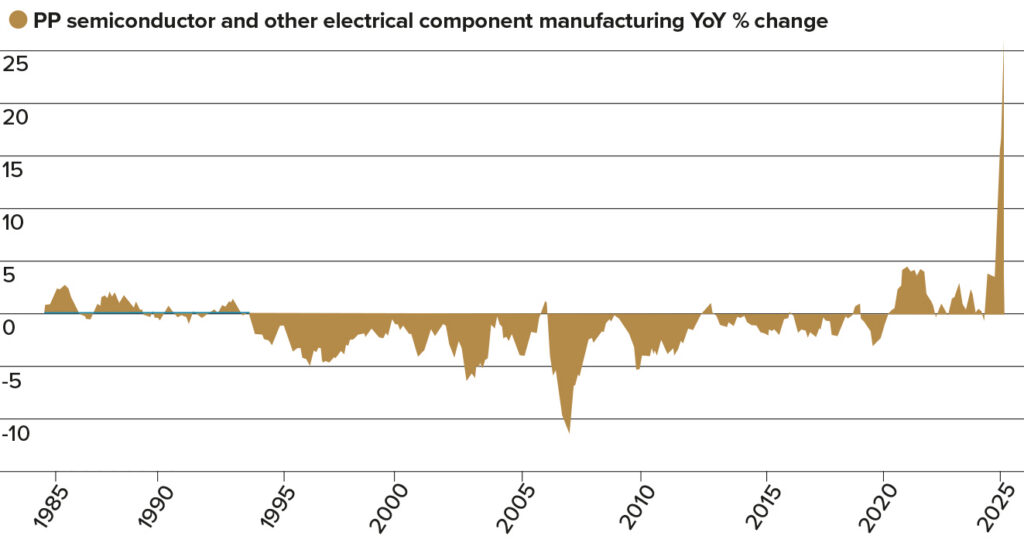
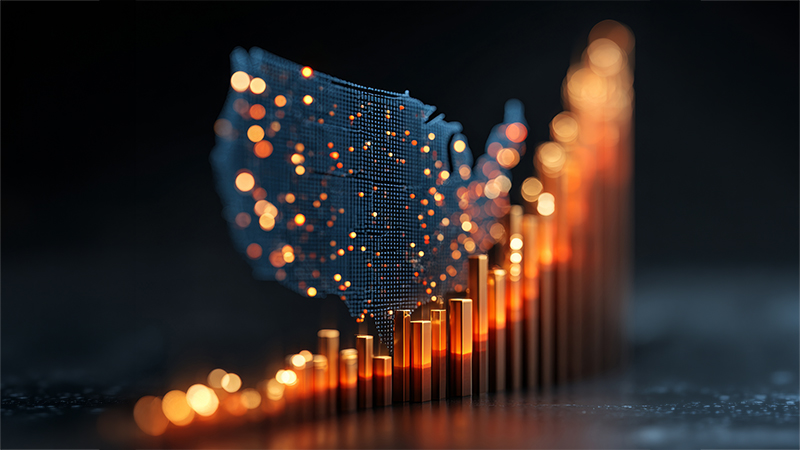
The chart below shows the year-on-year change in the US Producer Price index for semiconductor and electronic component manufacturing. For decades, compute benefitted from a quiet deflationary tailwind. More recently, that tailwind has faded. The price of intelligence is becoming more physical, more cyclical and more capital intensive.
The market is pricing AI as a digital, asset-light revolution. But what if hyperscaler capex keeps rising and today’s growth story becomes tomorrow’s depreciation cycle? Chips, power, cooling and replacement costs do not disappear; they move through the income statement. Margins compress, returns on capital fall and AI stops looking like software. It starts looking like infrastructure – or even industrial hardware. A very different multiple.
Welcome to the Dyson trade. A Dyson swarm is the ultimate capital formation machine: millions of solar collectors harvesting the sun’s energy to power civilisation. Space-based data centres are the baby version of that idea. Not a prediction, perhaps, but a metaphor: capitalism’s attempt to industrialise sunlight. If compute is no longer cheap on Earth, capital will try to move compute closer to the sun. The unintended consequence is that AI could become the most capital-intensive industry in human history.
SpaceX is not listing into the space age. It is listing into an AI capex supercycle. Investors may think they are buying Mars, rockets and Starlink, what they are really buying is an option on whether AI can escape the constraints of Earth. A trillion-dollar plus SpaceX valuation may not be a bet on Mars, but rather, that Earth is no longer big enough for AI.
For investors, the message is clear: do not chase the obvious hype, own the bottlenecks: launch; power; grid; cooling; optical communications; defence infrastructure and real assets. And in a world where capital is trying to industrialise sunlight, a bit of gold still makes sense too. The future of AI may be written in code, but it will undoubtedly be priced in watts.
AI’s hidden inflation problem – compute is no longer getting cheaper