







The portfolio manager’s view: George Cotton, portfolio manager, JSS Commodity Transition Enhanced fund
The energy crisis driven by the war in the Middle East has precipitated policy action. However, for the most part, developed market governments have focused on shielding consumers from price rises in the form of subsidies and price caps, much as occurred in 2022.
Energy price rises typically drive turnover at the ballot box, and long-term planning to ensure meaningful energy security is generally longer than an election cycle – prompting consumers to adapt in the absence of policy action.
In the wake of the last energy crisis, liquefied natural gas (LNG) shortages resulted in rolling blackouts across Pakistan, resulting in major political instability and economic insecurity.
In response, consumers took matters into their own hands, sparking a boom in rooftop solar installations to such a degree that major commercial coal-fired electricity generation projects were shelved as net electricity sales fell.
The researcher/strategist’s view: Hilde Jenssen, head of fundamental equities at Nordea Asset Management
Energy resilience is a major element of Europe’s ongoing strategic transformation, with significant investment needed for electrification and power infrastructure. Europe remains structurally vulnerable to gas flows from the Middle East, and the current conflict demonstrates how geopolitical tensions still matter for price formation and security of supply over the long term.
However, that vulnerability is precisely why this conflict is reinforcing – rather than derailing – investment in domestic energy security across Europe and allied markets.
Europe’s €300bn (£260.8bn) REPowerEU programme anchors a multi-year response focused on reducing import dependence through grid modernisation, accelerated renewables, energy storage, efficiency upgrades in buildings, and improved access to critical raw materials.
Similar dynamics are visible in the UK and parts of Asia, while the US benefits from its role as both a capital goods supplier and an energy exporter.
We think the most compelling potential sits in grid infrastructure and transmission, rather than upstream exploration or short-cycle fossil investments.
This involves upgrading ageing networks, expanding interconnectors and deploying advanced cables, transformers and digital control systems to handle rising electricity demand from renewables, industry, data centres and transport.
In addition, downstream electrification themes, such as energy efficiency in buildings, heat pumps, storage and power management technologies are appealing. This will reduce dependence on gas and improve system resilience.
Renewables and clean energy generation remain important, but without grid capacity and flexibility they cannot scale; as a result, capital is increasingly flowing into regulated networks, equipment suppliers and industrial supply chains that underpin electrification.
Supported by REPowerEU and national programmes, this long-duration investment opportunity is centred on predictable cashflows, high barriers to entry and a foundational rebuild of Europe’s energy backbone – not cyclical exposure to commodity prices.
The wealth manager’s view: Jonathan Unwin, UK head of portfolio management, Mirabaud Wealth Management
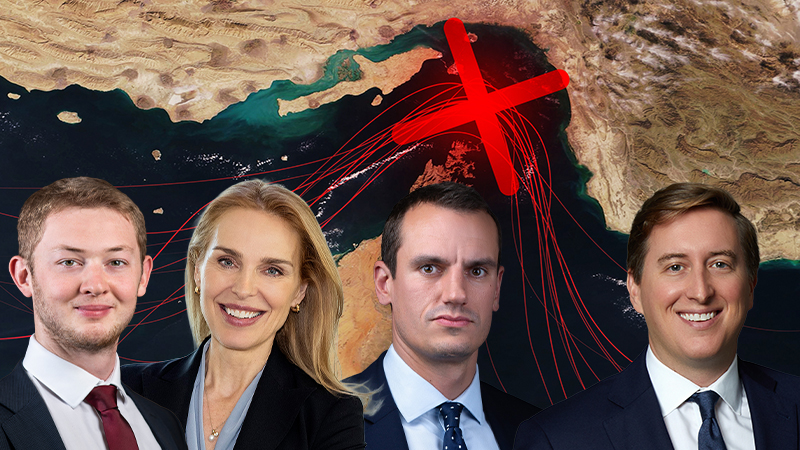
The conflict in the Middle East and the almost complete closure of the Strait of Hormuz has triggered many nations to reconsider the reliability of their energy supply chains. With change there will inevitably be opportunities.
Just as with the Covid pandemic, Ukraine war and aggressive US tariffs triggered many corporations and nations to a ‘reshoring’ of manufacturing facilities, while pivoting essential trade sources to more friendly origins, we are already seeing capital rapidly rotating out of choke-point dependent assets and into more steady geographies.
We are seeing an acceleration – particularly by emerging Asian economies – towards renewable energy, a rotation from Middle Eastern to Norwegian oil and gas, and significant investment flowing into infrastructure such as new pipelines and overland travel routes in order to bypass vulnerable choke-points.
While there are certainly regional opportunities with respect to energy investment, these are nuanced and specific. North America is probably the most obvious immediate economic winner, as it maximises traditional fossil fuel production with an existing infrastructure, but this does not necessarily translate to new opportunity.
However, federal capital flows into domestic nuclear energy, and the push to domestically refine critical minerals in the US, are investable.
In Europe and Asia there is a renewed urgency for solar, battery and wind power for the longer term as well as nuclear, while in other emerging economies such as Africa and South America there is renewed impetus towards hydro-power and biofuels. Ironically, the higher cost of hydrocarbons makes such projects more economically viable.
Furthermore, the recent energy crisis has acted as a catalyst for the theme of electrification, which has now become an issue of necessity as a hedge against fossil fuel market volatility rather than an ideological ‘green’ aim.
New life has been breathed into the adoption of EVs and electricity grid upgrades, including the development of AI solutions to manage the integration of renewables alongside traditional energy sources.
The multi-asset manager’s view: Tyler Rosenlicht, head of natural resource equities, Cohen & Steers
Attacks on critical energy infrastructure throughout the Middle East have created significant impacts on energy supply chains. Most notably, damage to Iran’s South Pars field and Qatar’s LNG export terminals has brought 17% of Iranian production offline for three to five years.
The result is that volatility and high prices will persist as the world’s energy system adjusts to these new dynamics. After all, shutting down infrastructure assets is an event while restarting them is a process.
As elevated energy prices persist, the risk of demand destruction increases, particularly in energy-importing regions, resulting in a renewed need for energy self-sufficiency. Energy inflation reduces real purchasing power and pressures margins, with more pronounced effects in Europe and parts of Asia, where dependence on imported energy is higher.
The US is more insulated given its status as a net energy producer, but higher gasoline and utility costs can still weigh on consumer confidence and spending, creating stagflationary risks globally.
This has been supportive for natural resource equities, particularly energy-linked equities. Oil producers and companies with direct sensitivity to higher crude and European natural gas prices have benefited, while a more extreme escalation could be a key downside scenario if inflationary pressures were to materially weaken demand.
Meanwhile, oil exposure has benefited from rising prices, while natural gas markets, especially outside the US, have seen sharper dislocations tied to LNG supply risks. Companies with direct exposure to US LNG exports have been relative beneficiaries, reflecting Europe’s reliance on imported supply.
Certain industrial metals tied to energy-intensive production such as aluminium are also sensitive to regional supply risks and power costs. Recent geopolitical events – not just the conflict in Iran – underscore minerals’ critical importance to political and economic stability.
We believe the reverberations from the conflict will have a lasting impact on energy markets and set the stage for a new geopolitical reality. Despite this uncertainty, real assets should remain resilient.
More broadly, we still expect a solid growth environment in 2026, with greater downside risks outside of the US, particularly if the conflict doesn’t resolve in a reasonable time frame.