
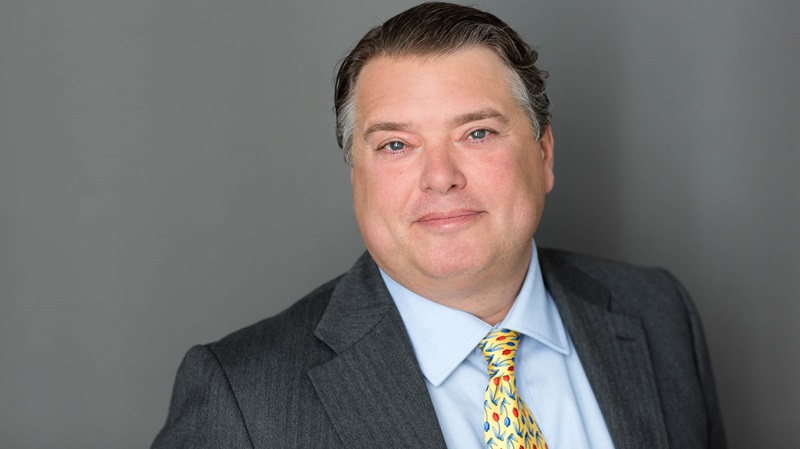




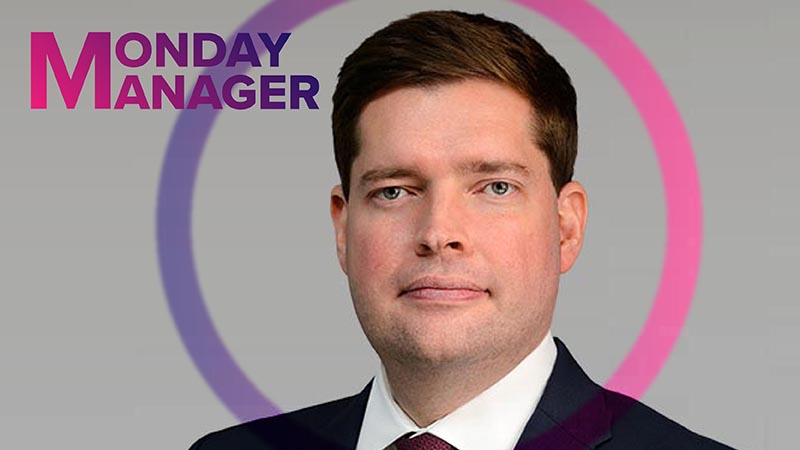

Marcel Stötzel, manager of the Fidelity European Trust, discusses solid fundamentals, working with industry veterans and his high conviction for European banks.
The Monday Manager series covers fund managers that have worked on their fund for over three years, and where fund assets are over £100m.
Can you explain the trust’s approach to investment and what it is trying to achieve for shareholders?
Our aim is for Fidelity European Trust to be a core, long-term holding for investors seeking exposure to European equities through different market cycles. Ultimately, we are trying to deliver attractive total returns, with a particular focus on sustainable and growing dividends, which we see as a strong indicator of underlying business quality.
In terms of how we invest, we focus on identifying companies with solid fundamentals — businesses that demonstrate structural growth, disciplined capital allocation and proven models. Cash generation is key for us, as it underpins a company’s ability to grow dividends over time, and we also place a strong emphasis on balance sheet strength to ensure that dividend growth is resilient.
We combine this with a clear valuation discipline, aiming to buy high-quality companies at reasonable prices. We take a long-term approach, typically holding stocks for three to five years, and we don’t have a bias towards any particular sector or company size—our performance is driven by stock selection.
How did you enter the world of investing and how did you come to run a European equity portfolio?
I’ve been passionate about investing since my teens, inspired early on by investors like Peter Lynch and Anthony Bolton. Graduating during the financial crisis meant opportunities in asset management were limited, so I began my career at Barclays in investment banking as a stepping stone. After completing my MBA at INSEAD, I joined Fidelity in 2015 as an investment analyst, initially covering European software and IT services before moving to aerospace, defence and airlines. In 2020, I became a portfolio manager alongside Sam Morse, focusing on our Europe ex-UK strategies.
European equities have had a strong start to the year. What have been the key drivers behind this and are these tailwinds set to continue?
European equities did start 2026 on a strong footing, but I’d characterise that strength as quite fragile. In the early part of the year, the drivers were fairly clear: improving macro expectations, a broadening of market leadership beyond US mega-cap tech, and a resilient earnings season that surprised on the upside. In other words, sentiment and fundamentals were briefly aligned.
That changed quite quickly. From March, the escalation in the Middle East triggered an energy shock, which fed directly into higher inflation expectations and a reset in interest rate expectations. Markets moved away from pricing ECB easing, and that shift has been a meaningful headwind for European equities, particularly given their sensitivity to energy and rates.
See also: Investors wrong footed again as US-Iran deadlock sends oil soaring
We did see a partial recovery in April, helped by a global risk-on move and continued earnings resilience. But near term, I remain cautious. Higher energy prices, uncertain consumer demand, and shifting rate expectations are likely to keep volatility elevated.
That said, the long-term case hasn’t really changed. European companies are global, cash-generative businesses, and the dispersion across the market remains a real opportunity for stockpickers.
Which sectors are you most excited about and why?
For me, it always starts bottom-up. We’re not trying to call sectors in a macro sense — we’re looking for companies with strong balance sheets, resilient cash generation and, crucially, the ability to grow their dividends through the cycle.
Within that framework, financials — particularly European banks — remain an area where we have high conviction. Structurally, this is a very different sector to what it was a decade ago. Balance sheets are cleaner, capital ratios are higher, and cost bases have been taken out. That means earnings are more resilient, especially in a world of “higher for longer” rates.
Yet valuations still don’t fully reflect that improvement. So you’re getting paid a healthy income today, with the potential for re-rating as confidence builds. That’s why we’ve added to names like BNP Paribas. Elsewhere in the sector we continue to like Deutsche Börse, which benefits from volatility and trading activity.
The other area I’d highlight — more contrarian — is airlines. It’s not an obvious call given fuel costs, but disruption tends to reduce capacity and strengthen industry dynamics. In that environment, the strongest operators win. Ryanair is a good example: structurally advantaged, taking share, and well placed to benefit from pricing over time.
Which parts of the market are you avoiding and why? Has this changed over time?
There aren’t many areas we would rule out outright, but we are cautious where the combination of fundamentals and valuation doesn’t stack up.
Luxury is a good example. We were long-term holders of LVMH, but we exited the position when the dividend stopped growing— that’s a red flag for us. More broadly, parts of the sector pushed pricing very aggressively through the Covid period, and I think that has stretched the relationship with the aspirational consumer.
You’re now seeing demand normalise, and in some cases soften, while the secondary market is no longer as supportive. Against that backdrop, valuations in parts of luxury still look quite full, which limits the near-term upside.
See also: Unicorn’s Mackersie: ‘Pay close attention to dividends’
More generally, we tend to avoid areas where pricing power is questionable, balance sheets are stretched, or where growth is overly reliant on favourable conditions continuing. Those are the sorts of businesses that can disappoint quickly when the cycle turns.
That said, our positioning isn’t driven by top-down sector calls. It evolves continuously as we reassess individual companies. If valuations reset or fundamentals improve, we’re very happy to revisit areas we’ve previously avoided—so nothing is ever permanently off the table.
What’s the best piece of advice you have received about investing?
The best piece of advice I have received is: “Investing, like sport, is as much mental as it is about raw talent. Making sure you are aware of your biases, making sure your investing style is congruent with your personality, and making sure you can handle setbacks are all crucial to success”.