





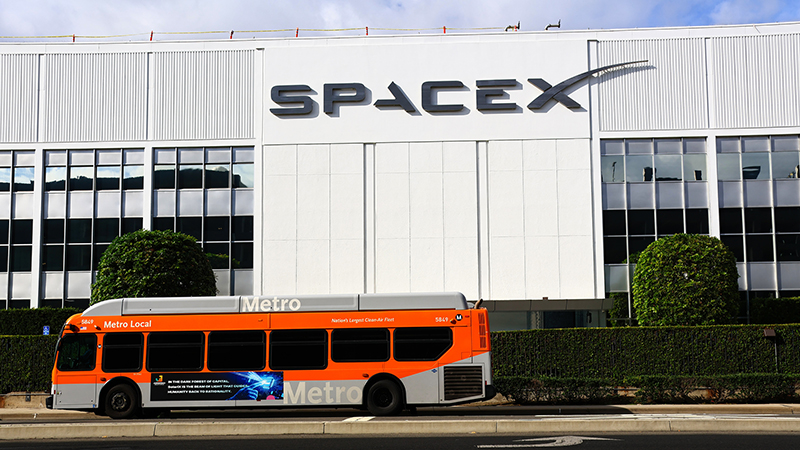

SpaceX, Elon Musk’s prominent space technology company, is rapidly approaching its initial public offering (IPO), set to be listed on public markets tomorrow.
The excitement has been high among investors, with the media dominated recently by discussions of the IPO and what it could mean for markets.
However, investors and asset allocators have warned investors they might want to stay cautious.
One of the biggest issues was around valuation.
Anton Du Plooy, 4factor analyst at Ninety-One, said: “Let’s start with what everyone is thinking, but few may want to say plainly.
“The valuation being ascribed to SpaceX is, by any conventional measure, extraordinary.”
Analysts have so far been unable to agree on whether SpaceX’s $1.75bn valuation is realistic, with analysts at Morningstar instead valuing the company at almost $780bn, a gap of almost $1trn.
Du Plooy noted: “SpaceX would arrive at a multiple well above what comparable businesses trade at today, and the mental gymnastics required to justify that number on fundamentals alone are considerable.”
Certainly, it has some attractive capabilities, with David Coombs, multi-asset manager at Rathbones, pointing to 10 million Starlink subscribers and the “genuinely transformative” rocket technology.
See also: Scottish Mortgage seeks approval to increase stake in private companies
“But extraordinary companies can still be terrible investments if you pay too much for them,” Coombs noted.
This valuation seems even more extreme because, based on currently available statistics, SpaceX is a loss-making business, having shed around $4.2bn in the first quarter, according to Abhimanyu Chatterjee, Dynamic Planner’s chief investment strategist
Tom Wildgoose, global equities manager at Sarasin & Partners, added: “What do you have to assume about SpaceX for $1.75trn to be the correct price?
“It’s not impossible, but you really have to make some quite extreme assumptions.”
This included assumptions about the company’s ability to deliver on promises such as data centres in space, or subscriptions, and whether it can turn a profit, he explained.
Dan Kemp, co-founder of Portfolio Thinking and former analyst at Morningstar, said it may be tempting to spread your expectations.
“Suppose Starlink reaches 180 million subscribers at today’s pricing, the market for AI services grows to $6trn within a decade with the company taking 15% of it, and the discount rate eases to 8.5%.
“Taken together, those assumptions achieve the asking price and not one of them, in isolation, looks ridiculous,” Kemp said.
But this presents its own set of problems, he noted, with the valuation now being dependent on whether several hopeful calls become true at the same time.
“For the holding to be genuinely attractive, for there to be any margin of safety, the story must be stretched further still, beyond the merely hopeful and into the frankly improbable,” Kemp warned.
That said, there’s some nuance to SpaceX’s upcoming listing, most notably the fact it is not IPOing the whole business, Sarasin’s Wildgoose noted.
It is only raising about $80bn, he explained, meaning the size of it in benchmark will be smaller than many investors may expect.
“The headline figures tell you it’s going to be enormous.
“But there’s loads of companies out there with a market cap of $80bn,” Wildgoose noted. From that perspective, active managers arguably do not need to decide on it immediately, he continued.
See also: GMO’s Inker calls private equity allocations into question
Index construction
However, experts also warned that passive investors who do not like SpaceX may not have much of a choice about whether they buy it.
Simon Evan-Cook, multi-asset manager at MGTS Downing Fox, said: “You might hate the idea of buying SpaceX shares, but you’ll still end up owning them.”
Financial markets usually have a rule where new shares must be listed for about a year or two before they get included in the index, allowing markets to notice if a stock was horribly overvalued at IPO, he explained.
“But the index providers have dumped this rule ahead of this particular IPO,” Evan-Cook noted. The Nasdaq, for example, will allow SpaceX to enter the index after just 15 trading days, and the FTSE Russell has moved in a similar direction, although there was some vagueness on timing, he said.
See also: Downing Fox’s Evan-Cook: ‘We could see Woodford repeated on a market scale’
Dynamic Planner’s Chatterjee explained this means when SpaceX IPOs tomorrow, every tracker fund following the Nasdaq will essentially buy it automatically.
Based on JPMorgan estimates, this means if SpaceX listed near its proposed price, investors may be forced to sell around $95bn of existing large-cap tech stocks, purely to maintain current weighting.
This will likely catch many investors off guard, particularly those who have built their own portfolio under the assumption that passive funds are well-diversified and prudent, he said.
“Their portfolio statement will show them a global equity tracker,” the Dynamic Planner strategist noted. “It will not show them that nearly half of that tracker is a wager on whether $690bn a year in AI infrastructure spending eventually earns its keep.”