





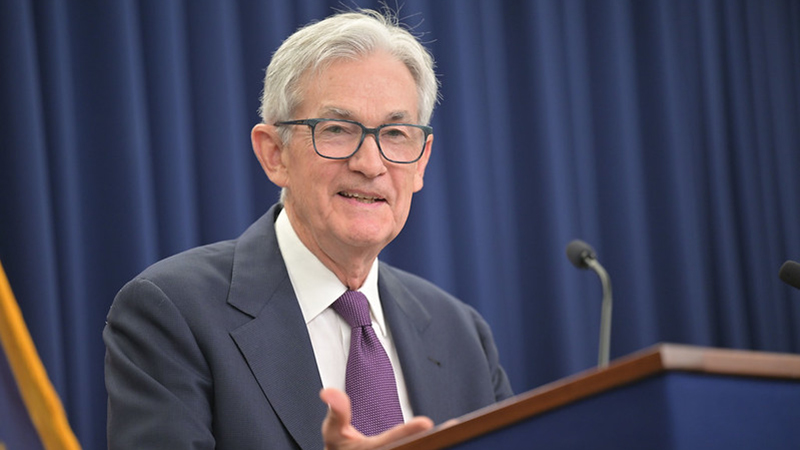

Jerome Powell used his last Federal Reserve meeting as chair to confirm he will stay on at the institution.
As widely expected, the central bank held the US federal funds rate at 3.5% to 3.75% for the third meeting running.
More interestingly, Powell’s accompanying comments contained the news that when Kevin Warsh takes over as chair next month, he will shift into a position on the board of governors until 2028.
This comes despite the continued hostility from President Donald Trump, and a Justice Department probe into Powell’s handling of the Federal Reserve building renovation, which was recently dropped.
Powell also indicated he and his colleagues see the economic situation in the US as finely balanced still, and that cuts or hikes in the near term are unlikely to be needed.
Whether Warsh sees it this way is very questionable, with his public comments generally indicating a much more dovish stance and a long history of advocating for lower interest rates.
See also: Bank of England risks ‘policy misstep’ as inflation rises
Daniel Siluk, head of global short duration and liquidity at Janus Henderson Investors, said: “On growth, the Fed’s assessment was essentially unchanged.
“Economic activity is still described as expanding at a solid pace, offering no indication that demand has softened enough to force the committee’s hand. This continuity matters: despite tighter financial conditions and slower hiring, the Fed sees no compelling evidence that growth itself is faltering.
“The labour market language, however, continues to evolve. The statement again notes that job gains have remained low, on average, reinforcing the idea that hiring momentum has cooled,” he continued. “But this acknowledgement is carefully balanced by the observation that the unemployment rate has been ‘little changed’.
“The most notable shift is on inflation. Inflation is now described as ‘elevated’, with an explicit reference to recent increases in global energy prices.”
Max Stainton, senior global macro strategist at Fidelity International, noted that the FOMC appears to be split to some degree.
See also: The hawk-turned-dove: Trump nominates Warsh as Fed chair
“For Powell’s last press conference as a Fed chair, it was clear Powell took a more committee-based approach to forward guidance.
“He reiterated that the ‘majority’ of the committee didn’t see the likelihood of hikes, and that the committee was still largely in a wait-and-see mode to assess how the ongoing shocks play out.
“Indeed, the biggest action from the press conference didn’t come from the discussion of the rate outlook, which in general remained clouded by uncertainty.
“Instead, it came from Powell’s revelation that he will be staying on as a Fed Governor after the end of his term as chair, arguing that current legal actions against the Fed are unprecedented, hence requiring his own unprecedented action,” Stainton concluded.
Jon Butcher, senior US economist at Aberdeen, added: “There was a single dissent to the vote to hold, with Stephen Miran favouring a 25bps cut. However, there were three further members who objected to the implicit easing bias in the FOMC statement.
“Powell added that the centre of gravity had shifted since the previous meeting, with more members seeing a rate hike as a possibility.
“Kevin Warsh’s nomination as Fed chair cleared the Senate Banking Committee earlier in the day and will now go to the Senate for confirmation. A Warsh chair will likely look at numerous reforms to the Fed’s operating framework, potentially including its inflation target.
“But switching away from core PCE inflation to median or mean metrics risks slowing monetary policy responsiveness and potentially raises questions about credibility.”
Butcher also noted his firm continues to expect the Fed to cut rates once in September and again in 2027, but risks are growing that rates stay on hold longer.