











Flows of cash into private credit funds are not yet showing signs investors are shunning the asset class in large numbers, according to Morningstar data.
The data shows allocations remain resilient so far this year, with total assets under management (AUM) continuing the growth seen over the past three years.
While dropping back from the large $1.9bn net inflow in December, flows were still well into positive ground in January and February, with figures of $513m and $594m respectively.
Looking at the flows over the past two years, a monthly figure of around $500m is close to an average level.
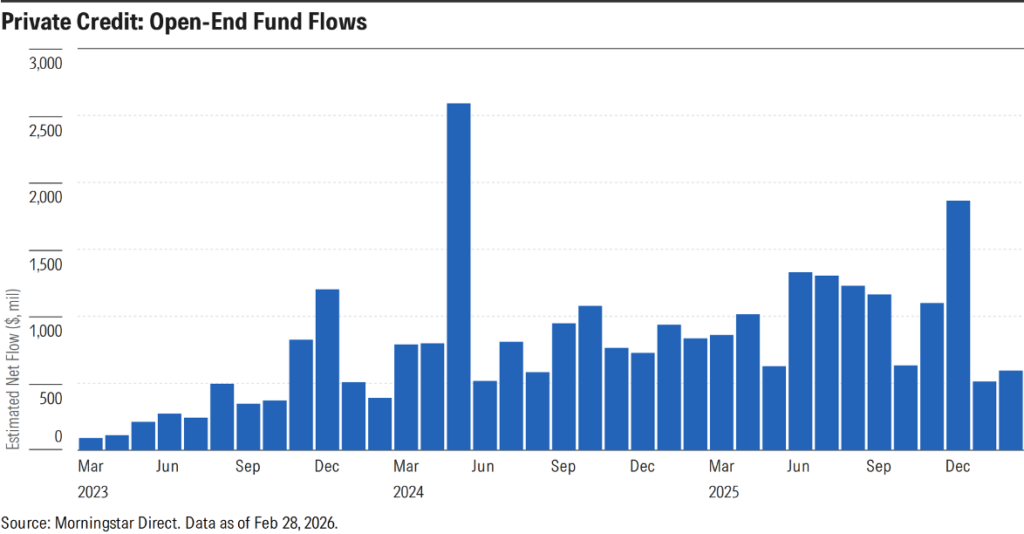
Total assets in private credit funds reached a new high of $57.3bn in February, thanks to the latest positive net flows.
Whether the trend will continue through the rest of the year is far from certain.
The private credit market is facing significant scrutiny as concerns build over investor demand for the asset class, liquidity and the quality of some of the underlying loans backing portfolios.
Mara Dobrescu, senior principal at Morningstar, said: “Private credit is clearly entering a more testing phase, with greater attention on asset quality, leverage and valuation transparency.
“Much of that scrutiny is now focused on semiliquid fund structures, which have played a key role in widening access to private credit but are also being stress‑tested by more challenging market conditions.
“So far, that pressure has not translated into a meaningful reversal of fund flows,” she continued. “Data through the first two months of the year suggests investors are continuing to diversify into private credit, albeit more selectively than before.
“While a few high-profile semiliquid funds have faced elevated redemptions in the US, inflows into private credit funds have remained steady in Europe, where many investors are only just beginning to add private assets to their portfolios.”