






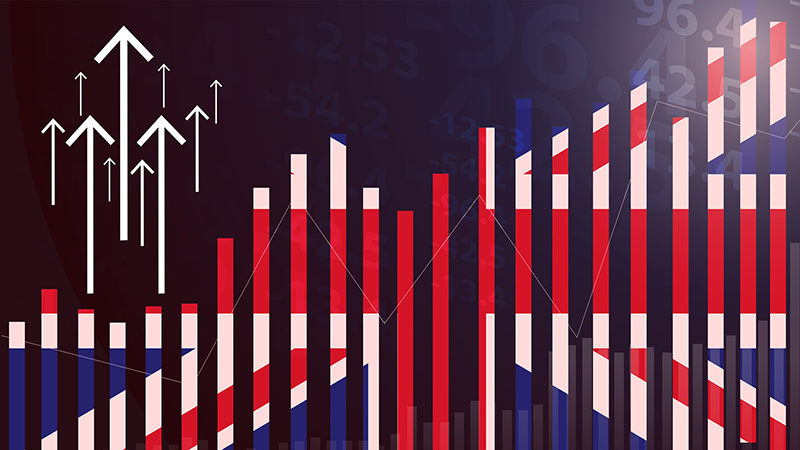

The UK economy grew a relatively strong 0.6% in the first quarter of the year, according to the Office for National Statistics.
This came despite the impact the Iran war has had on energy prices, and growth was stronger in March after the conflict began, with a 0.3% monthly expansion.
The services sector of the economy was the driving force behind the growth. However, the strength could be short-lived, with the energy price shock from the war yet to show itself in the data.
Economists will also be watching for any further signs interest rates will have to rise again to keep inflation in check, which would significantly hamper growth as the year moves on.
The news did little to increase investor confidence in gilts, with the 10-year at 5.04% and 30-year at 5.72% on Thursday (14 May).
Andrew Wishart, senior UK economist at Berenberg, said: “The UK economy’s strong start to the year was probably part truth, part statistical illusion.
“Quarterly growth of 0.6% in the first quarter of 2026 was the strongest since Q1 2025, in keeping with the recent pattern of strong economic momentum at the start of the year followed by a slowdown later.
“To cut through the noise we focus on annual growth. On this basis growth picked up only modestly, from 1.0% year-on-year in Q4 to 1.1% in Q1.
“Nonetheless, that gain, alongside the pickup in surveys of economic activity, suggests the economy regained some momentum before the Iran war,” he continued.
“Sadly the conflict will snuff it out, as costly energy imports divert spending away from domestically produced goods and services and the Bank of England (BoE) contemplates rate hikes to limit inflation.”
See also: Gilt yields rise again as Starmer fights to stay in Downing Street and Iran crisis rolls on
Danni Hewson, AJ Bell head of financial analysis, added: “While it’s evident the impact of higher prices driven by the Iran War will take time to weave its way into the UK’s economic fabric, it would be churlish not to highlight the surprising resilience of the country’s economy in the midst of geopolitical turmoil.
“After months of pre-budget speculation dampened sentiment in the second half of 2025, businesses had brushed themselves off, swallowed increased costs and started to feel more optimistic about the path forward.
“For the current chancellor it is a moment to look back at past choices and to consider that many policy changes don’t have an immediate impact on growth or sentiment, and with the wagons circling around Downing Street, there are questions about whether those changes will really have time to bed in,” she continued.
“But with inflation already hotting up and life expected to become more uncomfortable for us all in the coming months, this year’s early momentum might disappear as quickly as it did in 2025.”
See also: Three European equity managers: How we diversify portfolios in today’s markets
Neil Birrell, chief investment officer at Premier Miton, said: “As expected, economic growth in the UK bounced back a bit in the first quarter, matching forecasts. Since Covid, there has been a trend of Q1 being strong, then falling away through the rest of the year, which is again on the cards for this year.
“There is nothing in these numbers to get excited about, as the war in the Gulf will have a dampening effect, and the current domestic political wrangling will only have a negative effect on spending in all sections of the economy as uncertainty prevails. Nonetheless, the year got off to a good start,” he concluded.