




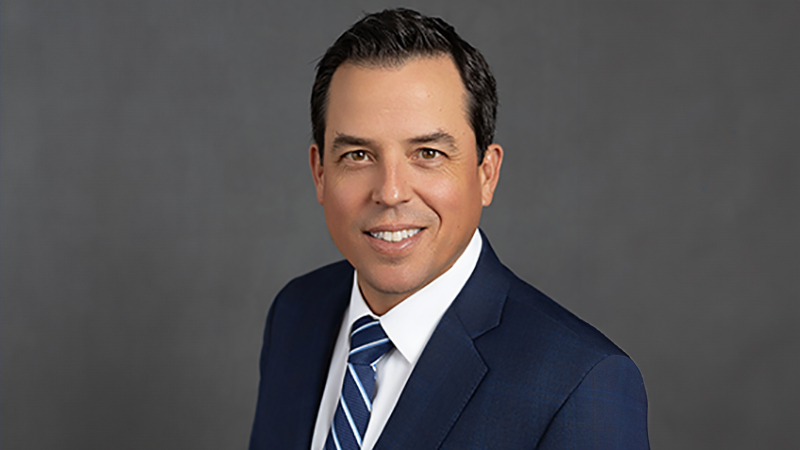



Dan O’Keefe, managing director and lead portfolio manager of the Artisan Global Value Strategy, discusses why successful value investing is about finding high-quality businesses trading at attractive valuations, the market’s reaction to AI-related opportunities and risks, and several of his portfolio’s high-conviction holdings.
The Monday Manager series covers fund managers that have worked on their fund for over three years, and where fund assets are over £100m.
Can you explain the portfolio’s approach to investment and what it is trying to achieve for investors? How do you define “value”?
The first thing we are trying to do is not lose money. Everything starts there. We don’t invest in highly leveraged businesses. We don’t invest in businesses we can’t understand. We are extremely careful about the valuations we will pay.
I will reluctantly call myself a value investor. I say reluctantly because value investing conjures thoughts of crummy businesses at low multiples. We love low multiples, but we hate crummy businesses. And I think that distinction gets at the heart of where value investing can go very wrong and how we might be different than some value investors.
You make money in two ways as an investor: from the multiple and/or from the growth in the value per share of the business. Value investing, at least the caricature of it, can’t get past the multiple.
See also: Monday Manager: Principal Finisterre’s Buchet targets high-carry income amid volatility
But outside of major market crises when lots of businesses trade at low multiples, a maniacal focus on the lowest multiple stocks tends to lead the investor to troubled companies. Sometimes the ship turns, but in my experience it often doesn’t. Time moves on and what you thought was a low multiple ends up being a fair or even expensive multiple because the profits didn’t grow or worse, shrank. That’s a recipe for losing money more often than not.
Which brings us to the second and often more important source of your return as an investor: growth in value per share. The compounding of earnings growth over time is the greatest tailwind to investment return. Growth of 7% a year is a cumulative 23% after three years and 40% over five years. And whether you paid 13x earnings for 15x earnings, you will still most likely make a great return if the earnings are 40% higher. Now if you paid 10x earnings for a business that doesn’t grow or shrinks over five years, the low multiple you paid is not going to bail out your return.
So, in summary, we are value investors who recognise that a truly undervalued stock is not necessarily the lowest multiple stock. A great business that can grow its value over time purchased at 15x earnings can be a much better value than a crummy business at 10x earnings. And believe me when I say that I have learned this the hard way over my 30-year career.
Which areas of the market are you most excited about and which areas are you avoiding?
We tend to think only about individual stocks, and we don’t invest based on themes or sectors. That said, AI is clearly reshaping the market landscape. Eight of the 10 best performers in the Global index in the most recent quarter were semiconductor companies. These companies, particularly manufacturers of memory semiconductors, are benefitting enormously from the AI related capital expenditure boom.
At the same time that the market is chasing these AI beneficiaries, it seems to also be on the hunt for AI losers. Many great companies in attractive industries have been sold down to attractive valuation levels based on what we think are pretty shaky theories about AI disruption.
This includes insurance brokers such as Marsh & McLennan and Aon, retail brokerage giant Schwab, and Iqvia, which runs outsourced clinical trials for pharmaceutical companies. We own all of these and have added to them on weakness this year.
Could you talk through a couple of examples of high-conviction stocks in your portfolio?
We recently added a position in Experian. The company has recently been sold down to what we think is a very attractive valuation. Experian is one of the leading credit bureaus in the world, and one of the largest owners of consumer data assets in general.
These data assets are used for all kinds of important decisions by clients, from extending credit, monitoring credit quality, verifying health insurance eligibility and marketing new products and services.
The business has grown revenue and profits at very attractive rates for a long time, and we expect it to continue to do so. But investors have recently sold it down from around 30x earnings to around 15x earnings because of fears that the data and the services it provides will be disrupted by AI.
We think this argument is weak given the regulated nature of the data and the proprietary nature of the analytics and services attached to it. We believe AI will be a meaningful benefit to Experian’s business and that the company will grow nicely over the next several years.
Schwab is a current holding that has also been caught up in the AI doom mongering and as a result, is selling for an attractive valuation. Schwab has taken and continues to take meaningful share in the wealth management space. It offers products and services at the lowest cost to clients in the industry, and it has the lowest cost structure in the industry, a powerful combination.
But some believe that AI will disrupt one of its key revenue streams, ie the interest income it earns on client cash balances. The argument asserts that AI enabled brokers will enable the daily sweeping of cash out of brokerage accounts into products that earn higher yields for clients, but lower income for companies such as Schwab.
We would note that Schwab already makes it easy for clients to move their cash into higher yielding securities should they choose to do so. Moreover, should the entire industry lose this stream of earnings, Schwab could raise fees slightly to make up for it, and still remain the lowest cost option to clients by far.
How positive are you in terms of finding new positions for the portfolio, compared to previous years?
A wise investor once told me: “Now is always the most difficult time to invest.”
We are pleased with the positions that we have recently added to (Schwab, Marsh etc.) and we are excited about the addition of Experian. Markets are always changing and we will deploy capital wherever we find the best opportunities.
What are some of the key themes affecting value managers over the long term, and how are you positioned for these?
I have no idea what the future will bring. I believe our investment philosophy makes sense, and I have been managing money using the same principles for decades. I have a large personal investment alongside my clients and my focus is always on managing through whatever the world throws at us and coming out on the other side with a decent return.
What is the best piece of investment advice you have been given?
I will turn it around and offer my advice instead. Be humble, think long term, and never stop learning.