







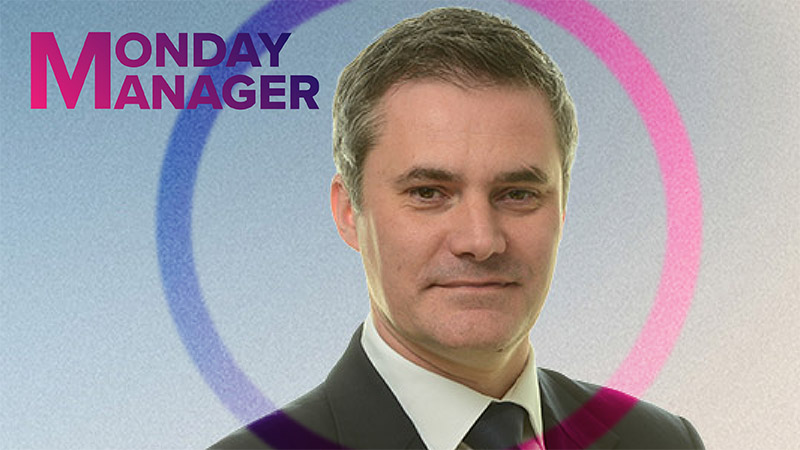

Roland Arnold, portfolio manager, BlackRock Smaller Companies Trust, discusses opportunities in companies where the AI threat has been overplayed, not building a portfolio around a single macro or geopolitical view and the best piece of investment advice he has ever been given.
The Monday Manager series covers fund managers that have worked on their fund for over three years, and where fund assets are over £100m.
Can you explain the trust’s approach to investment and what it is trying to achieve for investors?
BlackRock Smaller Companies Trust aims to deliver long-term capital growth by investing in smaller and medium-sized UK quoted companies. We are active, bottom-up stockpickers, so the starting point is always the individual business rather than a macroeconomic view.
The UK smaller companies market is a broad and often under-researched part of the market, which creates opportunities for active investors. We look for businesses with strong management teams, attractive market positions, good cash generation, pricing power and the ability to grow over the long term. Balance sheet strength is also important, particularly in a more uncertain economic environment.
The recent merger with BlackRock Throgmorton has created a larger investment trust with lower charges, greater liquidity but the core objective remains unchanged: to give shareholders long-term exposure to high-quality smaller companies where we believe the market is underappreciating the growth potential.
Alongside capital growth, the trust also aims to provide shareholders with a progressive dividend over time.
Which areas of the smaller companies market are you most excited about right now, and which are you avoiding?
One of the most interesting areas today is where the market has become too quick to extrapolate bad news. AI is the obvious example. There is no doubt it has the potential to disrupt business models, but the market’s reaction has often been to “shoot first and ask questions later”. That can create opportunities in companies where we think the AI threat has been overplayed or misanalysed.
More broadly, we are finding opportunities in selected domestically exposed companies where valuations appear to be discounting a very difficult outlook for a prolonged period. Parts of the housing and building materials supply chain are good examples. The near-term backdrop has clearly been challenging, but long-term demand drivers remain intact and, in some cases, valuations now look too pessimistic.
We also continue to find opportunities in businesses with resilient or contracted revenue streams, particularly where they are linked to essential services or infrastructure. These companies can offer greater visibility of revenues and cash flows, which is valuable in a more uncertain market environment.
On the other side, we are more cautious where the investment case has become less clear, where earnings visibility has deteriorated, or where customer demand is under pressure. That includes companies more exposed to weaker SME confidence, businesses facing execution risk as they expand into new markets, and companies where operational momentum is no longer supporting the valuation.
There’s a huge amount of geopolitical uncertainty in the UK right now. Has this affected your positioning? If so, how?
When it comes to geopolitics, making realistic short-term predictions is impossible. In markets like these, any forecast can be out of date almost as soon as it is made, so we do not build the portfolio around a single macro or geopolitical view.
If anything, the past few years have shown how dangerous that can be. Investors have had to deal with Covid 19, the war in Ukraine, banking stress, tariff uncertainty, renewed tensions in the Middle East, and now the prospect of further political turmoil in the UK. All of these have had consequences for inflation, supply chains, corporate behaviour and investor risk appetite.
What that has done is reinforce the importance of resilience. We want to own companies with strong balance sheets, adaptable management teams and business models that can cope with a more volatile backdrop. In uncertain markets, good companies can be sold off indiscriminately, but that does not mean every fall in share price is an opportunity. The key is to distinguish between temporary sentiment pressure and a genuine deterioration in fundamentals.
There has also been more turnover in the portfolio than in recent years, reflecting changes in the underlying investment universe and the need to keep the portfolio aligned with where we see the best risk-adjusted opportunities. As the number of listed UK companies has continued to fall, the average size of companies in the benchmark has increased. Owning somewhat larger and more liquid smaller companies can give us greater flexibility to be tactical when markets become dislocated.
Looking beyond politics and over the longer term, what are some of the biggest headwinds investors in UK smaller companies have to contend with right now? How are you mitigating these?
The biggest headwind is not a lack of good companies. It is a lack of appetite for the asset class. UK smaller and mid-sized companies have faced a combination of structural and cyclical headwinds: inflation, tight government finances, poor policy signalling, uncertainty around AI and, ultimately, persistent outflows.
Those outflows matter because this is a relatively illiquid part of the market. When capital leaves, valuations can be pushed down indiscriminately, regardless of what is happening at the company level.
We mitigate those risks by staying focused on company fundamentals. We want businesses with strong balance sheets, good cash generation, robust competitive positions and management teams with a proven ability to execute. Diversification is also important, both by sector and by business model.
The irony is that these headwinds are also creating the opportunity. UK valuations appear to imply something much worse than the economic reality suggests. In many cases, they also fail to reflect the long-term prospects of the underlying companies.
That disconnect is uncomfortable in the short term, but it is also where the long-term opportunity lies, with UK assets remaining inexpensive relative to other developed markets. For patient investors, that creates a compelling backdrop, but it requires selectivity and discipline.
What are the benefits of investing further down the cap spectrum at the moment, as opposed to in larger caps?
The attraction is that the market is giving long-term investors a very unusual entry point. Sentiment towards UK small and mid-cap equities remains subdued, but we continue to see clear evidence of value, both in absolute terms and relative to other markets.
Smaller companies are typically less well researched than larger businesses, which can create pricing inefficiencies. In periods of stress, that inefficiency can become even more pronounced, with investors selling first and doing the detailed analysis later. We are seeing examples of that today, particularly where concerns around AI disruption or the UK economic outlook have led to indiscriminate selling.
Corporate activity is another sign that valuations are attractive. Public markets are currently placing very little value on long-term growth in UK smaller companies, yet strategic buyers are still prepared to act. That tells you something: they can see value that public markets are not recognising.
The investment trust structure is also important. Smaller companies can be less liquid, so having a closed-ended vehicle allows us to take a genuinely long-term view. We are not forced sellers during periods of market weakness, which is a significant advantage when investing in this part of the market.
What is the best piece of investment advice you’ve ever been given?
The best investment advice I’ve ever received was simply: buy good companies. That sounds almost too obvious, and at times like today it can feel a little frustrating when share prices seem disconnected from underlying fundamentals. But investing doesn’t need to be overly complicated. If you back high-quality businesses, run by management teams you trust, and give them time, the odds tend to work in your favour.
Markets can be noisy in the short term, but over the long-term good companies have a habit of proving their worth.