







In the latest in our regular series, fund group distribution bosses share their thinking on asset classes, strategies and working with clients over the next 12 months.
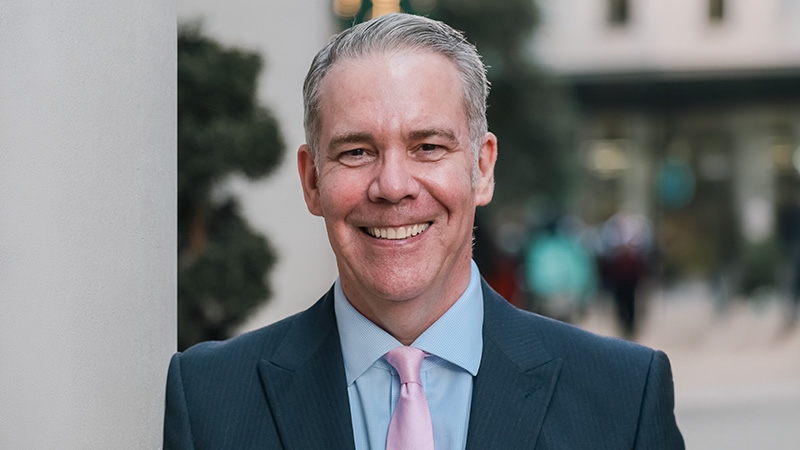
Gary Tuffield (pictured below), partner at Goodhart Partners, discusses tackling unsustainable global debt levels, frothy private equity markets and why prioritising cost may prove… costly.
Which particular asset classes and strategies do you anticipate your intermediary clients focusing on this year and into next?

Inflation’s resurgence after the pandemic caught many off guard, exposing the shortcomings of conventional asset allocation models in protecting investors’ purchasing power – an issue that may persist. Global debt levels are now unsustainable, and demographic trends are reversing, both of which are deeply interconnected and unfortunately weigh on growth rates and government spending. If savings represent deferred consumption, then debt is simply consumption brought forward. We’ve effectively borrowed tomorrow’s growth, and the bill is now due – yet there’s scant appetite to finance already over-indebted countries.
Given this backdrop, it’s no surprise that geopolitical tensions are elevated and long-bond yields are moving higher. Add expensive aggregate equity valuations to the mix, and you have the recipe for a fundamentally different economic and market environment.
See also: Goodhart hires Gary Tuffield as partner and member of managing board
Against this landscape, flexibility is paramount. Investment strategies that eschew rigid index constraints and focus on company fundamentals are best placed to adapt to this new regime – and ultimately outperform in the years ahead. Longer term, we are bullish on disruptive technology companies, which typically reside much further down the market-cap spectrum.
Should end-investors – and, by association, asset managers – be thinking beyond equity and bond investments? Towards what?
Protecting and growing investors’ real wealth, against a very challenging backdrop, will require an absolute return mindset and a wide opportunity set. Strategies that take responsibility for both the return and the absolute level of market exposure should be able to navigate a more volatile economic and market environment.
To what extent do private assets and markets fit into your thinking? What are the currents pros and cons for investors?
Private equity markets currently look very frothy, particularly when compared to public equity markets. While significant capital has flowed into private assets, our concern is growing that retail investors risk becoming ‘exit liquidity’ through a proliferation of unsuitable vehicles. The industry has a persistent habit of reinventing itself with novel – sometimes overengineered – investment approaches and structures, ostensibly to justify its existence and revenue targets. Warning shots fired!
Given client and regulatory pressure on charges, how is your business delivering value for money to intermediaries and end-clients?
Being a private partnership without any external shareholders allows us to incentivise and align ourselves with that objective and therefore with the interests of our clients. Capacity management is often compromised to the short-term benefit of shareholders, but at the expense of clients. We believe that scale is the enemy of truly active fund management – those who abuse it have often suffered the consequences – typically through alpha degradation.
Prioritising cost may prove…costly! Most large and, often, listed asset management groups can no longer embrace active fundamental fund management; this has led many to prioritise cheap beta and enhanced index capabilities that can scale to infinity. This is a huge boon for differentiated boutiques that remain true to their core values.
How much of your distribution is currently oriented towards climate change, net zero, biodiversity and other segments of sustainable investing? How do you see this approach to investing evolving?
Each of our investment strategies has an agile investment approach and a reason for existing. Our most flexible mandate, Goodhart Global Real Return strategy, affords us the ability to invest in any company, up and down the market cap spectrum, across any industry, anywhere in the world, and to take as much or as little net exposure to risk assets as is appropriate to the environment.
To navigate a cycle, which we feel is coming (for the avoidance of doubt), we believe in embracing flexibility and in being very deliberate in the types of investments we may want to own for our investors.
Starting valuations, and the price you pay for a company’s future earnings stream, irrespective of the industry, is important in making successful long-term investments, as is understanding the risks to those assumptions.
Our approach is to remain nimble, ensuring we can adapt when warranted – be it because opportunities have arisen, or because they are scarce.
How are you now balancing face-to-face and virtual distribution? In a similar vein, how are you balancing working from home and in the office?
I like working with my colleagues and a few of them even seem to tolerate me! There is no substitute for in-person interactions, whether they be internal or external. However, I’m also laser focused on costs and efficiency, and in that spirit, Teams can be helpful for introductory or review meetings, especially with clients based outside of London.
What do you do outside of work?
I read – and voraciously, at that! I also like to chase a small white ball around manicured fields, which brings varying degrees of satisfaction.
What is the most extraordinary thing you have seen in your life?
My children being born. All three of them. Each time, a real miracle.
Looking a little further ahead, in what ways do you see the asset management sector evolving over the next few years?
Active fund management has been in the doldrums (insert any # of years) and many asset owners and even several larger asset managers have capitulated on this once-productive endeavour. At Goodhart, we are capitalising on others’ disenchantment, and even bewilderment, by doubling down on the art of fundamental analysis in the belief that correctly forecasting the earnings power of a business will be rewarded through share price outperformance over time – something that has not necessarily been the case for the last 10 years.
Over this period, weak companies have benefited from passive flows and cheap borrowing costs. Our contention, and raison d’être, is that creative destruction will assert itself; good companies will be rewarded, and poor companies will fail, thus leading to greater stock dispersion. The level of corporate debt refinancing from 2026 to 2028, is likely to amplify ‘good vs bad,’ as levered companies and broken business models are facing the prospect of significantly higher borrowing costs.
Looking ahead, artificial intelligence (AI) stands poised to reshape the economy and society, potentially, even more profoundly than the Industrial Revolution. AI is at once the great white hope and the great unknown. Asset management groups that understand it and can implement AI across their investment and operating platforms will have a huge advantage. Legacy systems and outdated mindsets pose significant obstacles; only those willing to embrace innovation will thrive.