






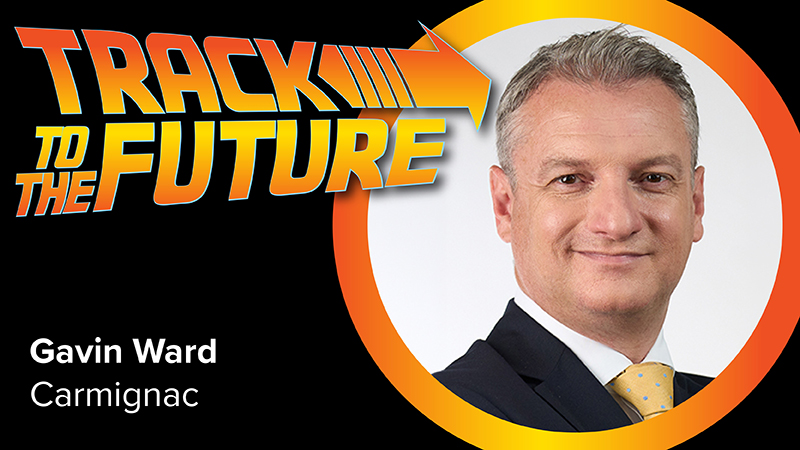

In the latest in our regular series, Track to the Future, fund group distribution bosses share their thinking on asset classes, strategies and working with clients over the next 12 months.
Here Gavin Ward, head of UK business development at Carmignac, EM equities, sustainability and why it is important to remember “elephants don’t gallop”.
Which particular asset classes and strategies do you anticipate your clients focusing on this year and into next?
Our clients continue to show strong interest in emerging market equities, and we believe the investment case remains compelling. Some of the world’s most innovative and strategically important technology companies are based in Asia, and the complexity of modern supply chains has created a huge level of interdependency, which benefits these companies.
Emerging markets have been under-owned in portfolios for several years and continue to trade at a substantial valuation discount to US equities, making them especially attractive for investors seeking diversification.
We have also seen demand for European quality equities, where fundaments are becoming more attractive. Over the past year, clients have leaned more towards value, however, as national resilience, industrial policy and energy security come to the forefront, we expect to see a meaningful re-rating in high-quality European businesses which, in our view, have been oversold in recent years.
European equities are a key conviction for Carmignac – we recently hired a top-performing portfolio manager Frederic Jeanmaire, who, upon joining, will co-manage one of our European equity funds. It’s a hugely exciting chapter for us and we look forward to having him on board.
Should end investors – and, by association, asset managers – be thinking beyond equity and bond investments? Towards what?
We still believe equities will remain the primary driver of long-term returns. Technology in particular is an area where we see a lot of potential, but it’s important to look beneath the surface. As active, high-conviction asset managers, we take time to analyse and understand different parts of the AI value chain. Some areas of AI have become crowded and expensive, while others continue to offer strong fundamentals and attractive valuations – selectivity and expertise have never been more important.
See also: Track to the Future with JPMAM’s Bergweiler: ‘We are seeing strong interest in liquid hedge funds’
We have also seen an increase in demand for liquid multi-asset and macro strategies, which can help clients diversify risk and protect capital more effectively. It is an area where Carmignac has a long heritage through its flagship Patrimoine strategy.
The demand for such products is driven by the current geopolitical and macroeconomic environment, whereby inflation is likely to remain at higher levels than investors have become accustomed to during the last decade.
To what extent do private assets and markets fit into your thinking? What are the current pros and cons for investors?
Private markets are part of our broader alternatives strategy. We have already launched an evergreen private equity strategy combining secondaries and direct investments through both SICAV Part II and ELTIF structures. These solutions appeal to certain client segments within the UK wealth market, notably ultra-high-net-worth investors and family offices.
We have an exclusive strategic partnership with Clipway, a recognised specialist in the secondary private equity market, which allows us toaccess high-quality direct co-investments with a very efficient fee structure to the advantage of investors.
That said, the UK industry is still at a relatively early stage of development in this area. There are operational, liquidity and educational elements that still need to evolve, and it will be interesting to see whether demand for structures such as LTAFs accelerates as many expect.
Given client and regulatory pressure on charges, how is your business delivering value for money to intermediaries and end clients?
Cost is clearly an important consideration for clients, but it is rarely the sole driver of investment decisions. Ultimately, value for money comes from a manager’s ability to deliver differentiated returns and consistent alpha over time – our emerging markets strategy, a part of our UK-domiciled OEIC range, is a great illustration of that.
See also: Track to the Future with Aubrey’s Pinner: There are multiple catalysts changing asset management
The scrutiny on asset managers’ fees and ability to outperform will only continue to intensify, which is why it’s important to demonstrate differentiated thinking and ability to outperform the benchmark.
A high active share – the percentage of a portfolio’s holdings that differ from its benchmark index – is a good indicator of an investor’s differentiated approach to stock selection. So-called closet index funds will find it increasingly difficult to justify fees while essentially mirroring the index.
How much of your distribution is currently oriented towards climate change, net zero, biodiversity and other segments of sustainable investing? How do you see this approach evolving?
As a family-owned business with a genuinely long-term perspective, sustainability has been embedded in our culture and investment process for many years. Stewardship is an important element of that – we regularly engage with investee companies on a multitude of ESG topics – from responsible AI to capital allocation and governance – to drive better outcomes for investors.
We have invested heavily in proprietary ESG research capabilities and in expanding our sustainability team under Lloyd McAllister.
More broadly, we see sustainable investing continuing to mature. The conversation is becoming increasingly focused on measurable outcomes, materiality and long-term stewardship, rather than simply labels or marketing language. We think that evolution is healthy for both investors and the industry overall.
How are you balancing face-to-face and virtual distribution? And how are you balancing working from home and in the office?
Asset management has always been a relationship-driven industry, and I believe it always will be. Trust, credibility and human connections still matter enormously – many of the client relationships we have today developed over many years.
Digital communication can never fully replace that human interaction, but the industry has evolved significantly. Consolidation has concentrated decision-making among increasingly busy fund selectors who are managing huge demands on their time and attention.
Realistically, it is not always possible to meet every client as frequently as we might like, so virtual engagement and digital distribution have become important ways of maintaining regular dialogue and staying connected when clients have competing priorities.
We support flexible working. In sales, we naturally spend a lot of time away from our desks meeting clients, so getting together in the office is still really important. It’s a great way to stay connected with colleagues across different teams and keep up to date with what’s happening across the business.
I’ve also found that some of the best ideas come from spontaneous conversations that wouldn’t necessarily happen on a video call, so I don’t see office working becoming redundant any time soon.
What do you do outside of work?
I enjoy spending time with my family and relaxing on the golf course – although my golf is probably best described as enthusiastic rather than accomplished.
I also love travelling and experiencing different cultures. One of the great advantages of working for an international business like Carmignac is the opportunity to see the world through different perspectives. The food and wine are usually pretty decent too!
What is the most extraordinary thing you have seen in your life?
It may sound like a cliché, but Chelsea winning the Champions League in Munich has to be up there.
I was there with my dad, which made it especially memorable. Chelsea were huge underdogs, massively outnumbered by Bayern fans in their own stadium and widely expected to lose. Didier Drogba was extraordinary that night and the atmosphere was unforgettable.
Supporting a football club through both good and bad times creates a real emotional connection, and to finally see your team reach the pinnacle of European football was genuinely special.
Looking further ahead, in what ways do you see the asset management sector evolving over the next few years?
The industry will continue to evolve, as it always does, and innovation will remain important. But amid all the technological change and product development, it is important not to lose sight of the core purpose of asset management – generating strong long-term returns for clients.
In many areas of the market, those returns are still driven by disciplined, high-quality stockpicking.
There has understandably been a huge shift towards passive investing and low-cost beta over the past decade, but markets will never become perfectly efficient. Inefficiencies create opportunities, particularly in areas such as technology and emerging markets, where active managers can identify businesses and trends that broad indices may miss.
I worked with a fund manager many years ago who used to say that “elephants don’t gallop”. Right now, a passive large-cap US technology investor may be very happy with their returns, but they could still be missing some of the most exciting opportunities elsewhere, particularly across Asian mid-cap technology businesses that already dominate important parts of the global supply chain.
Passive strategies will continue to play an important role, but active management still has the unique ability to uncover future winners. Today’s mid-cap innovators can become tomorrow’s Nvidia or TSMC — the potential two-baggers, three-baggers or even more that can ultimately supercharge investment returns for clients.