

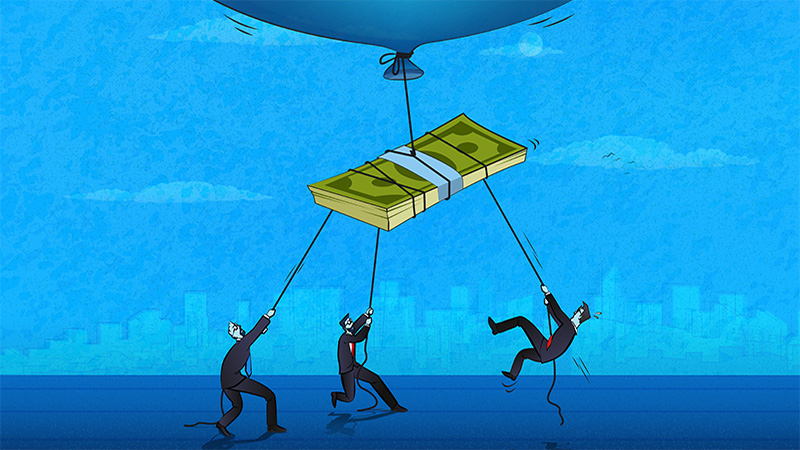






Outpacing inflation remains a constant battle for portfolios, with sticky inflation running the risk of eating into the gains savers make on their investments.
Daniel Casali, chief investment strategist at wealth management firm Evelyn Partners, noted: “Legendary investor Warren Buffett described inflation as a ‘tapeworm’ that quietly consumes purchasing power.
“It remains one of the most vivid descriptions of a challenge that investors continue to face today.
“Ultimately, successful investing is not simply about generating positive returns, but it is often also about ensuring wealth grows faster than inflation,” he said.
Inflation in the US has risen by about 3.7% since the end of the Second World War, he noted, a useful starting benchmark for assessing real returns. Based on MSCI data from December 1994, technology stocks were the best defence against inflation, having produced an annualised real return of 10.7% in dollar terms.
Next closest was health care stocks at 7.7%, a three-percentage-point drop from technology stocks. Even the worst-performing sectors in Evelyn’s data (materials and communication services) still delivered real returns of more than 4%.
Meanwhile, bonds were a comparative laggard, delivering from about 0.6% to 2.5% real returns, depending on maturity.
“Long-term averages tell an important story, but market leadership does not remain constant,” Casali said. “Periodically, major structural shifts emerge that reshape the investment landscape.”
Since the explosion of AI with ChatGPT’s launch in 2022, market leadership has shifted significantly, according to the Evelyn Partners investment strategist.
See also: HSBC’s Sahni: How should investors navigate AI’s inflation arc
“Since November 2022, information technology, which includes semiconductor chip manufacturers and many AI beneficiaries, has generated annualised real returns of 29.1%, nearly three times its already impressive long-term average,” he said.
Communication services have similarly surged, up some 21% since the launch of ChatGPT. For comparison, they delivered an annualised real return of just 4.6% since December 1994.
“By contrast, traditionally defensive areas such as healthcare and consumer staples have underperformed relative to their historical norms,” Casali added. Healthcare, for example, has only delivered annualised real returns of about 3% since November 2022, while staples are only marginally better at 3.2% (compared to 7.7% and 6% since December 1994).
That said, AI was not the only way to make good returns since the introduction of ChatGPT. Indeed, gold has generated an annualised real return of 21.8% since late 2022, making it the second-best performing sector on the list.
The yellow metal’s rise was attributed to surging inflation post-pandemic and sharply rising government debt, throwing fiscal sustainability into question.
With Russia’s invasion of Ukraine causing many of its foreign exchange assets to be frozen, banks and sovereign wealth funds have diversified their holdings using the precious metal, according to the investment strategist.
See also: Knacke’s money map: Are you ready for gold round two?
“Historical performance shows the most effective defence has been owning assets capable of growing faster than inflation,” Casali said. “For much of the past three decades that has meant equities.
“Since the arrival of ChatGPT, the share prices of technology and AI-related businesses have been growing faster than inflation.
“Whether that leadership endures remains uncertain, but the shift in market performance has been unmistakable,” he concluded.