





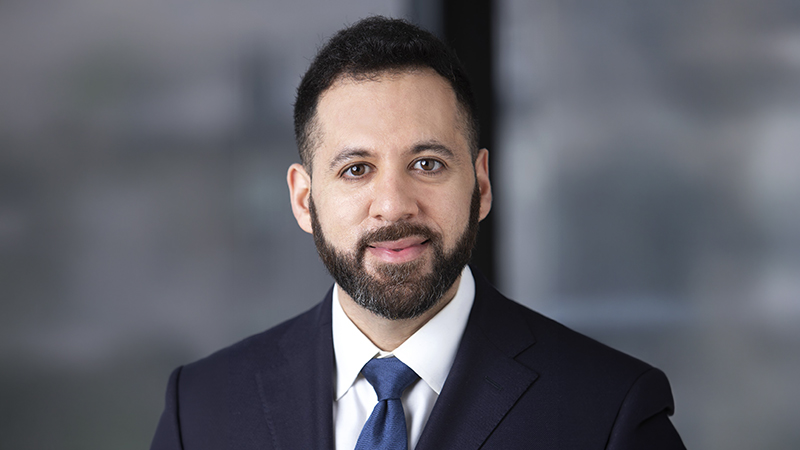


Ibrahim Kanan, portfolio manager of BlackRock’s US Flexible Equity fund, explains why the greatest opportunities in US equities may lie beyond the magnificent seven, how AI is creating winners across the “other 493”, and why disciplined execution matters as much as investment insight.
Can you explain the fund’s approach to investment and what it is trying to achieve for investors?
The BGF US Flexible Equity fund is designed to help investors access the full breadth of opportunity in the US market, not just the handful of mega-cap stocks dominating the index. We take a selective, active approach to identify companies we believe can drive the next phase of market returns, while helping clients diversify concentration risk and gain exposure to powerful long-term themes.
What are the key challenges to navigate across the US equity market at the moment?
The biggest challenge is concentration. A relatively small number of companies have accounted for a disproportionate share of index returns in recent years. That has worked well while those companies have led the market, but it has also left many investors exposed to a narrower set of return drivers.
Relying on such a concentrated group to continue delivering growth in the same way is becoming less clear cut, recent bouts of volatility have demonstrated how quickly the same names that previously supported portfolios can become a source of vulnerability.
While some investors may look to other indices for “diversification” away from the S&P 500’s top-heavy bias, leaning away could mean neutralising AI outperformance.
Companies in the “other 493” are often still able to benefit from the themes driving the magnificent seven, while being at more attractive valuations given that they are essentially emerging from a two-year earnings recession.
What are some of the biggest tailwinds?
The US continues to benefit from one of the strongest earnings backdrops globally, with corporate profitability proving resilient and earnings growth broadening beyond the largest technology companies.
The last earnings season was incredibly strong and showed that this trend of improving earnings and market breadth is underway, however, we continue to believe that there are further tailwinds to support the US, from a strong macro position to superior earnings growth.
A key tailwind is AI and we continue to see AI investment creating opportunities across multiple parts of the economy. This is evident in the AI infrastructure but also increasingly among companies using AI to improve productivity, efficiency and costs to ultimately drive margin expansion and market share gains.
More broadly, improving manufacturing activity, infrastructure investment and reshoring trends are supporting earnings recovery in sectors such as industrials.
This is helping to provide a wider set of opportunities than the market has experienced over the past few years and multiple tailwinds that we look to get exposure to, as always, by taking an earnings-first approach with the knowledge that corporate fundamentals are the ultimate driver of returns.
What have been some of your best-performing stocks over the last year, and why?
Technology has remained the largest contributor by sector, particularly driven by stock selection beyond the magnificent seven.
A key example is Ciena, an AI infrastructure company addressing one of the critical constraints in the AI buildout: networking capacity. Ciena’s optical interconnect technology supports the fast and efficient transmission of data to GPUs in data centres. That makes it an important enabler of AI infrastructure, yet it represents only a very small share of the index.
Industrials have also contributed meaningfully. Wesco has been a notable contributor, with the industrial distributor benefitting from positive manufacturing trends and stronger ISM data. Importantly, none of our top 10 relative contributors were magnificent seven stocks, highlighting the value of looking beyond the market’s biggest names.
Why are investors choosing an active approach today?
Many clients want to maintain their US equity exposure but are becoming more conscious of concentration risk within indices.
In their core exposures, they are increasingly looking for differentiated sources of alpha, greater diversification beyond the mega caps, and access to opportunities that may be too small to have a meaningful impact on benchmark returns but can still generate significant value for active investors.
What is your outlook for the US market?
Despite the S&P 500 reaching new highs, earnings growth continues to support valuations. We believe the opportunity set is broadening beyond the largest stocks and that active investors are well-placed to identify the next generation of market leaders.
While today’s winners may remain important, history suggests leadership changes over time, making selectivity increasingly valuable.
How did you enter the world of investment?
Growing up, I loved math and science and that led me to pursue a technical degree in mechanical engineering from MIT. My first exposure to markets came during a summer internship where the company I worked at was in the process of going public – that was the first time I learned about the public markets.
That led me to the investment banking division at Goldman Sachs in New York, where I worked with companies across a range of industries and saw how strategic decisions ultimately translated into business value.
From there, I moved to Global Infrastructure Partners. This was an important formative experience because it forced me to think like an owner: if you are buying a business you may hold for several years, you need to understand the durability of its earnings, the quality of its assets and what could change the value of that business over time.
However, I found that I missed the dynamism of public markets, so I turned to BlackRock Fundamental Equities taking that long-term earnings approach that I learned in private equity but applying that lens to publicly traded equities.
This remains central to how I invest today: an earnings-first philosophy, deep fundamental research but overlaid with disciplined portfolio construction translating those insights and maximising stock-specific returns.
What is the best piece of investment advice you have ever been given?
The best piece of investment advice I’ve received is that investing isn’t just about having great insights – it’s about being able to execute on them. There are a lot of fundamental investors with good ideas. The harder part is implementing those ideas consistently, particularly when markets become volatile or the consensus is moving against you.
That’s one of the reasons I’m such a strong believer in combining fundamental research with systematic data-driven tools.
The fundamental work helps us develop differentiated insights into earnings and business fundamentals, but the systematic framework helps us translate those insights into portfolio decisions in a disciplined way.
It takes some of the emotion out of the process and allows us to focus on what the data and the research are actually telling us.