











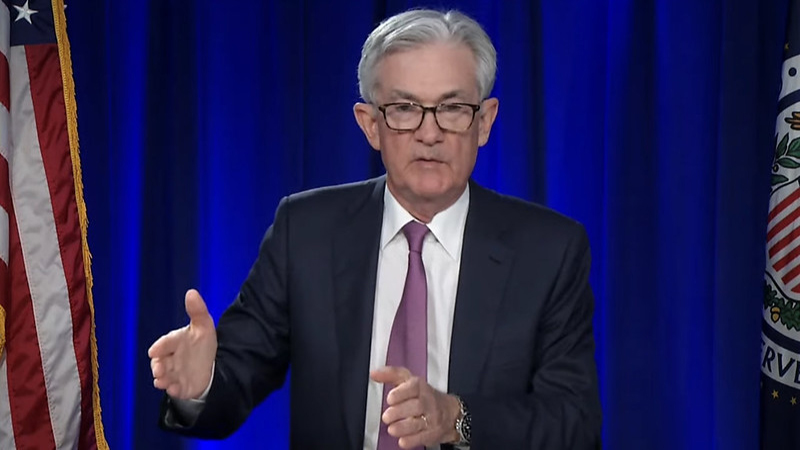


As is often the case with Federal Reserve meetings, investors will be listening closely today for hints on the moves to come later in the year and next.
Markets have already priced in a 25 basis point cut for today’s October meeting, so attention will be on the commentary from Chair Jerome Powell accompanying the decision.
Any deviation from the expected quarter point cut would be a shock, whether a 50 point cut, or no cut at all. It is an unlikely scenario but would cause significant movement in the markets if it happened.
There are signs the US economy has slowed more than the Federal Reserve had earlier expected, with job layoffs picking up significantly. This may be the basis for Powell to strike a dovish tone in the commentary alongside the decision and in his press conference.
He is also under significantly political pressure to ease policy, with President Donald Trump and members of his administration being highly critical of the slow pace of cuts. Powell of course insists the data on the economy is the only thing he is influenced by.
Working against the possibility of a pick-up in the pace of rate cutting is the lingering problem of inflation. It remains slightly above target in the 3% area.
Matthias Scheiber, head of multi-asset solutions, Allspring Global Investments, said: “We expect the FOMC to cut benchmark rates by 25bps [today], with broad support across the committee.
“This would align with market pricing and follow the 25bps cut delivered in September. However, forward guidance may be more mixed, in our view, likely carrying a mildly hawkish tone.
See also: Wealth manager Q&A with SJP’s Lord: ‘Ultimately, this is a people business’
“We will be watching for the phrase ‘data-dependent’ in the Chair’s remarks and how the balance of risks is framed- key indicators to validate this view. As such, we believe the market may be slightly over-optimistic about a December cut. This cycle has shown a tendency for pricing to become overly aggressive in both directions.”
Erik Weisman, chief economist and portfolio manager, MFS Investment Management, said: ‘A 25bp cut appears to be a foregone conclusion on October 29th given labour market concerns.
“The September CPI print is based on a limited sample with a high noise-to-signal ratio and is unlikely to sway the FOMC decision one way or another. There seems to be faith in the thesis that tariffs are a one-time price shock.”
“Upside surprises in services inflation have not been a major part of the discourse either. Instead, the Fed’s focus has been on weak payrolls. Labour market slack, via its influence on wages, plays a critical role in determining services ex-shelter inflation. Given this context, the laser focus on jobs is not misplaced.
“Thus, at this juncture, the labour side of the mandate is dominating. If inflation remains sticky at a high run rate well into the first half of 2026, the Fed may loosen less than the market is pricing, but that would be a story for a later date.
“Waller, one of the most dovish members of the FOMC, recently mentioned that he is looking for data to reconcile the apparent disconnect between the weak labor market and robust spending. His unraveling of this puzzle will be critical for him in deciding the course of policy beyond October.”
See also: Does the gold price crash signal full reversal or short-term correction?
Richard Potts, economist at Bondford, added: “In a welcome development for the US economy, the delayed release of CPI data landed below expectations, reinforcing the case for further monetary easing. Markets now view a 25bps rate cut [today] as a near certainty, with a high likelihood of another similar move in December.”
“The downside surprise reinforces the view that the inflationary impact of Trump’s tariffs have both been overstated, and will prove transitory. This gives the Federal Reserve renewed scope to focus on the other half of its dual mandate — the labour market — and continue cutting rates with confidence.
“Even in the absence of official data, private-sector surveys and the Fed’s own analysis suggest the jobs market is still deteriorating, raising the stakes for policymakers,” Potts continued.
“Today’s CPI print gives the Fed breathing space. With inflation undershooting expectations, policymakers can stay focused on supporting the jobs market — though they will be wary of moving too aggressively before the data pipeline fully normalises.”