




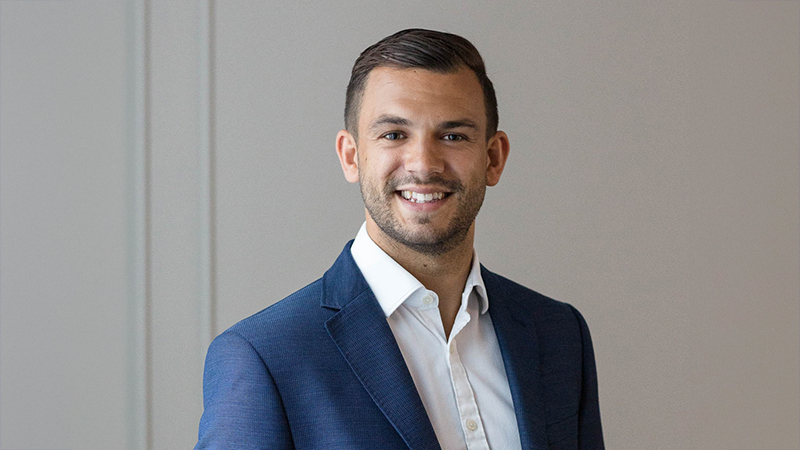


Given investors must have at least one eye on the future, Portfolio Adviser wanted to offer readers an idea of how some of the next generation of investors view the world. In this instalment of Generation Next, William van der Weyden, investment analyst at Guinness Global Investors, discusses the outlook for global equities and managing uncertainty.
Is there a particular asset class grabbing your attention at the moment? Why?
As a long-only equities investor, it feels predictable to say “equities,” but I’m going to anyway… What’s particularly interesting right now is the sharp divergence within the asset class. It’s been a very positive year for global equities, but this performance hasn’t been equally shared.
AI euphoria has caused both ‘Defensives’ and ‘Quality’ to lag behind the more speculative areas of the market, despite fundamentals holding up nicely. This has left many solid businesses looking really attractive relative to the rest of the market. If you put that in the context of a market that is seemingly increasingly concerned over potential macro risks (particularly an AI bubble…), owning companies with strong balance sheets, high returns on capital, and consistent cash generation seems very sensible in this kind of environment.
How do you see sustainable and ESG-oriented investing evolving from here?
ESG has shifted from being a “nice to have” to something people expect companies to get right – a hygiene factor. Strong governance, environmentally friendly policies, and positive social impact are no longer just abstract ideas but the bar for what a high-quality company should look like. For companies to simply ignore these standards would be to risk shareholder pressure and reputational damage. I expect that over time, the distinction between “ESG companies” and “non-ESG companies” will blur, and the differentiator will be those who manage risks from these three factors of E, S, and G effectively.
What will be different about the investment sector a decade from now?
Even over the past five years, technology has had a massive impact on the role of the equity analyst, and I expect this trend to continue. It’s gradually shifting analysts back towards the parts of the job that matter most – information interpretation and decision-making.
The amount of information we deal with keeps increasing, but so do the tools that help us process it more efficiently. I expect analysts will spend far less time on data gathering or cleaning and far more on analysing scenarios and working out what truly drives stocks. The informational edge will continue to narrow – not disappearing entirely, but becoming less of a differentiator. The advantage will increasingly lie with investors who can cut through the noise, identify what actually matters, and translate that into a clear, well-judged position, rather than simply having and processing more data than their peers.
What led you into a career in investment?
I’ve always been numbers-driven. I studied maths and physics at university, and thinking analytically and in a formulaic way comes naturally to me. But I’ve also been very interested in history, geopolitics and how the world fits together. Global equities sit right at the intersection of all these topics. It’s an asset class that’s seemingly infinitely deep and diverse, incorporating economics, psychology, science, technology, politics, and more – and these things are constantly changing. That mix really appeals to me. It means you’re constantly learning and reassessing, and never short of something new to explore.
What are your plans for your next holiday?
I’m not great at sitting still, my holidays usually need to involve some challenge or adventure. In September, my best friend and I wanted to do something we’d never done before, so we took a mountaineering course in the Alps that ended with an attempt at summiting Mont Blanc. Unfortunately, the weather stopped us three-quarters of the way up, but it was an incredible experience, and we were desperate to give it another go as soon as we could, so we’ve booked to do it again next year. Hopefully, with some better weather.
Are you incorporating AI into your work processes?
Yes, definitely. AI has already become a really useful tool and a massive efficiency enhancer, helping me sort through data, write code and macros, help with Excel formulas, and handle more repetitive tasks. That frees up more time for the more important aspects of the job, like interpreting information and taking an informed view. I’m not convinced it will ever replace decision-making itself, but it does make it easier and faster to reach the higher-value parts of the research process.
What piece of advice do you wish you had been given on your first day as an investor?
That you can’t know everything, and that’s okay. Early on, it’s easy to think that adding more detail or building more complex models will give you the answer – but often the simplest models are just as effective as the most complex ones. Even if you do come up with the theoretically correct answer, it doesn’t mean you’re going to be rewarded for it – there are just too many variables, especially when considering human/behavioural biases in the market. Focusing on the big picture, strong risk management, thinking long-term, cutting through the noise efficiently, and sticking to processes in a disciplined way matter more than having perfect information.
Is there anything that has surprised you about a career in investment since you started?
What’s surprised me most is how often good investing comes down to managing uncertainty rather than finding perfect answers. You can have a well-reasoned, fundamentally sound view and still not see that reflected in the share price for a long time, or conversely, you can be wrong and the market might not punish it immediately. That disconnect can be uncomfortable.
What really helps is having a clear process, the right mix of conviction and humility, keeping focused on the numbers rather than just the narrative, recognising when bias might creep in, and being open to changing your view. All of these matter just as much as the analysis itself when it comes to making good decisions.