











By Abhi Chatterjee, chief investment strategist at Dynamic Planner
In a market increasingly defined by the dominance of a select few technology behemoths, investors face a critical dilemma: how to access the engine of innovation without being overly exposed to stretched valuations and sector concentration.
The magnificent seven have driven the S&P 500’s recent ascent, creating a concentration risk where a handful of stocks dictate the market’s fortunes. Their ‘priced for perfection’ status leaves little room for error, a reality starkly illustrated by the recent market turbulence following the release of new AI models by DeepSeek. This event triggered a swift correction in stocks related to the AI ecosystem, serving as a powerful reminder of how a single development can send shockwaves through a market built on a narrow foundation.
The greater challenge for investors is therefore to find a way to capitalise on innovation without succumbing to the inherent volatility of an over-concentrated, over valued market.
The best of both worlds
Enter the convertible bond, a sophisticated hybrid that offers a potential solution in a top-heavy market. This instrument marries the security of debt with the upside potential of equity, providing a strategic entry point into high-growth companies. At its core, a convertible bond acts like a traditional corporate bond, guaranteeing the repayment of principal at maturity. The key differentiator, however, is the embedded option to convert the bond into a predetermined number of shares.
The value of a convertible bond is a function of three key elements. The bond floor acts as a safety net, representing the instrument’s minimum value as a fixed-income security. Above this floor, the bond’s value is influenced by its conversion price – the stock price at which it becomes profitable to convert. When the underlying stock’s market price surpasses this level, the bond’s value is driven by parity, or the direct value of the shares it can be exchanged for.
This structure provides investors with a managed exposure to high-growth companies, capturing potential upside while offering a crucial layer of downside protection.
For issuers, the rationale is equally compelling. Convertible bonds offer a significantly cheaper source of funding, especially for growth-oriented companies and startups. By embedding the equity option, issuers can often secure a lower interest rate, with many convertibles even structured as zero-coupon bonds. While these instruments are having a moment in the modern market, their history is long. They were used by canal and railroad companies in the 19th century and famously by IBM in 1980 to finance a major takeover.
Another way
To truly understand the strategic value of convertible bonds, we undertook an analysis of the ICE US Convertible Bond index against the MSCI USA index, using historical data since 1987. The findings suggest these hybrid instruments offer an alternative solution to navigating the inherent issues existing in today’s equity markets.
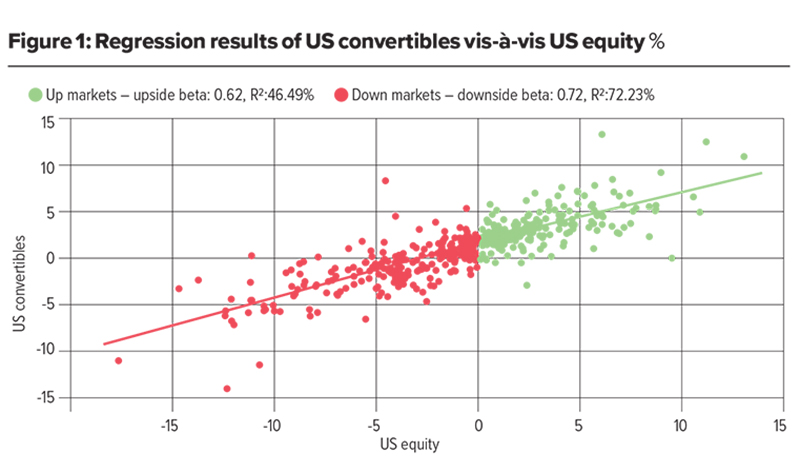
A core tenet of convertible bond investing is the bond floor: the fixed-income component that theoretically cushions against sharp market downturns. Our regression analysis, which separated returns into up and down markets, strongly supports the value of this aspect of the instrument.
The results show the convertible bond index captured 72% of the downside equity returns in periods of decline (see figure 1). This is a significant finding, confirming that convertibles offer a meaningful degree of capital preservation during market corrections.
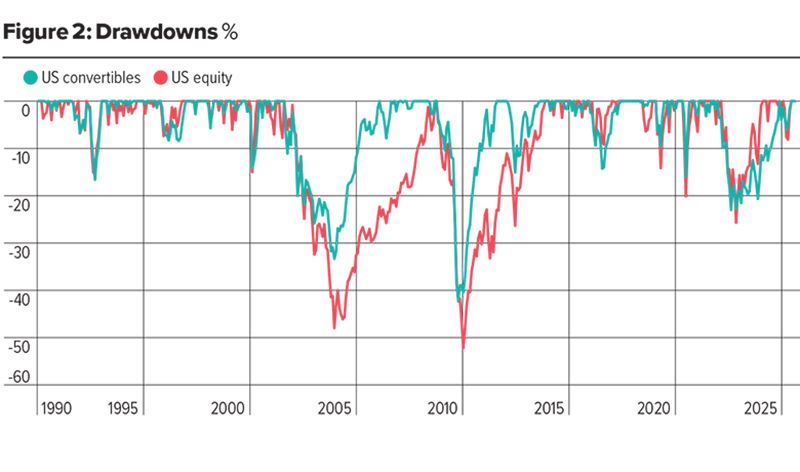
As illustrated in the comparative drawdown analysis (figure 2), convertibles not only suffer less severe drawdowns but also tend to recover more swiftly from market troughs.
Demand dynamic
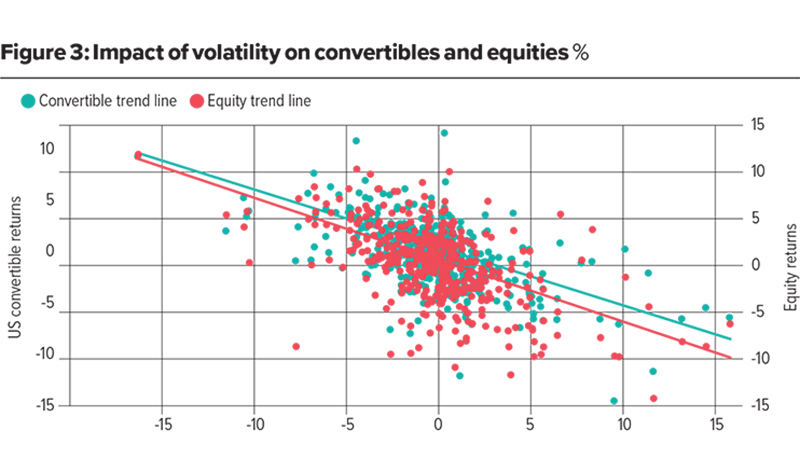
Another critical factor in the valuation of convertibles is implied volatility – a non-technical measure of the market’s expectation of future price swings. This is particularly relevant due to the embedded equity option. Higher market uncertainty leads to increased demand for protection, which, in turn, drives up the price of options and, by extension, the value of the convertible’s embedded optionality.
Our analysis confirms this dynamic: as figure 3 shows, convertible bonds tend to deliver superior returns relative to plain-vanilla equities when volatility is rising, a unique and valuable characteristic. Given these benefits, we explored the impact of adding a convertible allocation to a traditional equity portfolio.
By testing allocations of up to 30% to convertibles, we found a persuasive case for diversification. The results, shown in figure 4, demonstrate that incorporating convertibles generally reduces realised volatility and mitigates the severity of the worst drawdowns.
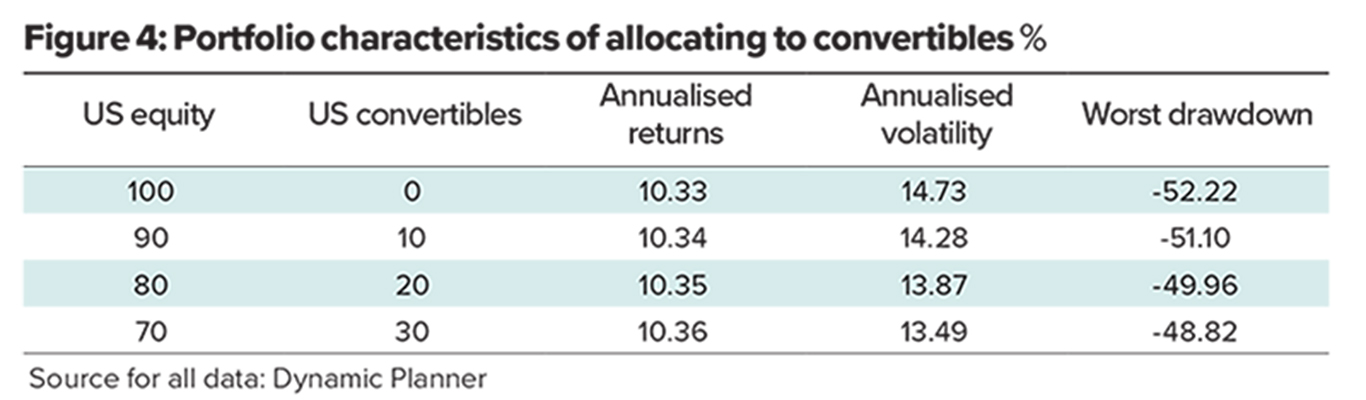
Crucially, this enhanced risk management does not come at the expense of returns, as the portfolio’s annualised performance remains stable. This observation presents an encouraging path for investors seeking to optimise their risk-return profile in an increasingly challenging market.
To conclude, while historically seen as a niche product, the convertible bond market is now experiencing a structural resurgence. The era of low interest rates, which favoured traditional debt, has given way to a new macroeconomic reality where the appeal of cheaper, hybrid financing is undeniable.
This has spurred a dramatic surge in issuance, which totalled $80.1bn (£59.45bn) globally for the first six months of 2025, a 17.6% increase on the same period last year and the strongest first half since the peak of the market in H1 2021 ($127.7bn), according to Debtwire.
The key distinction this time is not just the volume, but the quality of the issuers. Companies across the high-growth spectrum, from technology and e-commerce to healthcare and emerging mobility, are tapping into this market.
Unlike the S&P 500, which is heavily weighted towards a handful of mega-cap technology firms, the convertible bond universe offers access to the next generation of innovators. This democratisation of capital-raising provides investors with a powerful tool to diversify their portfolios beyond the crowded US large-cap space.
For allocations struggling with concentration risk, the convertible bond could be a useful strategic alternative.
This article originally appeared in Portfolio Adviser’s October magazine