







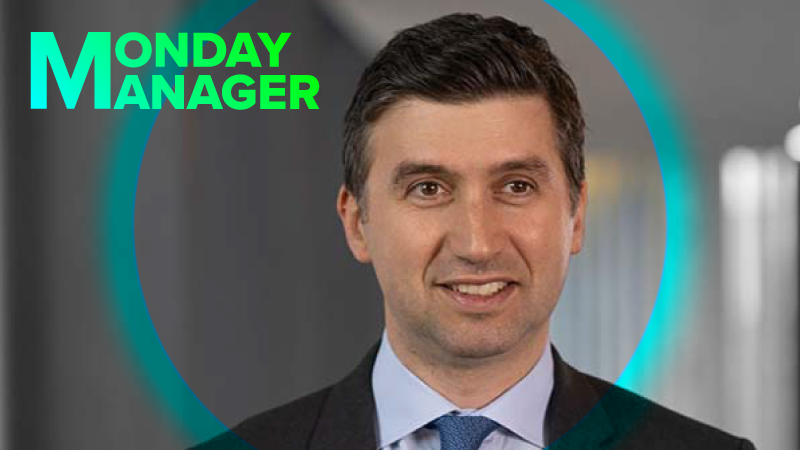

Mikhail Zverev, co-manager of the Amati Global Innovation fund, discusses how his team avoids the “magnificent seven effect”, why radio pharmaceuticals and defence tech are ripe for investment, and how they aim to uncover truly mispriced innovation.
How do you define the investment philosophy behind the Amati Innovation fund?
Mikhail Zverev: Innovation creates a lot of value, but it’s fundamentally mispriced – it’s complex and uncertain. Investors often anchor in the past and miss the inflection points. We aim to exploit that inefficiency by looking for innovation off the beaten track.
We’re not going to be an innovation fund that just brings you the magnificent seven in a different order. Since launch, our active share versus the benchmark has been between 98% and 99% – we are very, very differentiated.
See also: Amati: Zverev and Bencke on innovation frontiers and the risks of ‘falling in love with science’
Would you say that performance has been uncorrelated with broader markets?
We’ve definitely experienced the challenges of being different. We have a pronounced mid-cap bias – around 60% of the fund sits in companies with a market cap between $2bn and $25bn. And our sector skew is towards technology, healthcare and industrials – we don’t own utilities or consumer staples. So, when markets panic, our complexity and cyclicality are against us.
But we are pragmatic. We invest in real businesses, not science projects. Our holdings are profitable and cash generative, which gives us confidence during volatile periods. We’re not reliant on the capital markets showing up in two years’ time to fund our companies.
We talk about innovation frontiers – areas where real change is happening now. Not futurism, but actual commercial adoption. And we map participants in those frontiers as pioneers (the inventors), enablers (the arms dealers), and adopters (those who benefit laterally).
One area I doubt you hear about often from fund managers is radio pharmaceuticals – precision medicine going nuclear. Imagine a heat-seeking missile targeting a tumour: an antibody binds to a cancer cell, carrying a tiny radioactive isotope. That isotope glows in the dark, enabling imaging, and the next step is treatment – you send a stronger isotope that burns the cell down. It’s highly targeted, reducing collateral damage compared to chemotherapy or radiotherapy.
Are there investable companies in this area already?
Absolutely. We own an Australian company called Telix, which has one of the best-selling imaging agents and a strong pipeline. We also invest in a classic enabler – a business that supplies isotopes to multiple players in the space. It’s a very closed industry, so there are massive barriers to entry, which we like.
Defence technology seems increasingly topical. How do you approach it?
We identified defence as a key innovation frontier when we launched over three years ago. Even back then, we believed ESG and defence were compatible – that’s more accepted now.
The industry is going through a second derivative shift: not just spending more, but spending differently. Defence needs now include counter-drone technology, cyber warfare and AI-enabled situational awareness. We own Leonardo DRS, which leads in onboard computing and sensors for tanks, and Booz Allen Hamilton, the top IT consultancy to US defence and intelligence agencies.
How do you assess companies when so much of their work might be classified?
Enough is disclosed to make a judgement. We follow the defence sector closely and compare what we see with larger players like Lockheed Martin. Our focus is on companies aligned with where budgets are shifting – towards smarter, more agile technology.
What about automation trends – are you seeing opportunities there too?
Yes, logistics and retail automation are often overlooked. Post-Covid, there’s been a renewed push to modernise. One fascinating area is RFID – think of it as an electronic barcode you can read wirelessly from 30 feet away. Every UPS parcel and many items in stores such as Uniqlo and Zara now have RFID chips.
We own Impinj, a leader in RFID technology, and Zebra Technologies, which makes the readers. It’s a high-volume, recurring revenue model. Another play is VusionGroup, a French firm that makes electronic shelf labels. They’re rolling out with Walmart in the US and the Co-op in the UK.
Given your contrarian approach, how has performance fared since launch?
The fund launched in June 2022. We’re in the global flex-cap peer group and are in the top quartile over three years. That’s despite not owning the magnificent seven, which is almost by design. We’re pleased to have delivered something different – and profitable – for our clients.
And you’ve got real skin in the game?
Very much so. My co-manager Graham Bencke and I seeded the fund with our own money. Between us and our third team member, Gareth Blades, we’ve got deep experience in aerospace, biotech and semiconductor physics. We go deep – we attend trade shows, talk to companies outside investor conferences, and follow the trail of innovation wherever it leads.
See also: Why Amati is launching a global innovation fund amid growth sell-off