





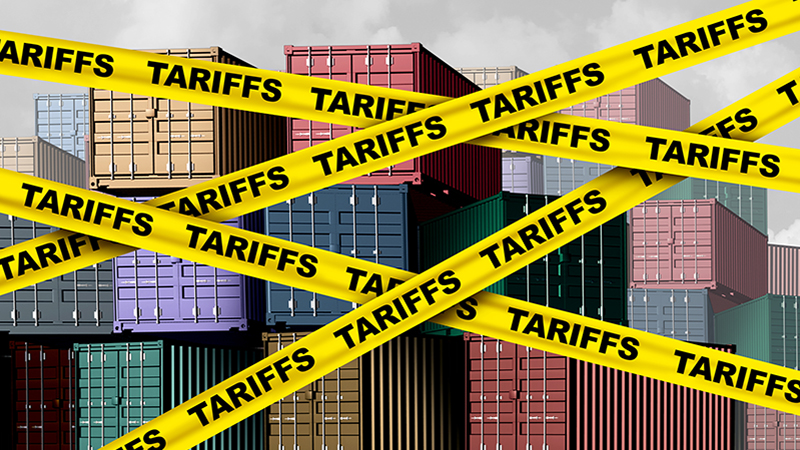


This time last year, US President Donald Trump issued a wave of tariffs on every major market, known as Liberation Day for investors.
The initial stockmarket impact was severe, with most global equity markets sliding in tandem in the initial aftermath. Markets such as the S&P 500 and the Topix fell by double digits in the immediate aftermath, with all major global equity indices in the red until the end of May 2025
Vincent McEntegart, investment manager at Aegon Asset Management, said: “The first anniversary of Liberation Day is a reminder of the first widely cited example of the Trump Always Chickens Out (TACO) trade.”
Trump campaigned on a bold tariff policy, he explained, but when it was implemented, the negative response was so fast that Trump backed down. By 9 April, the US president had announced delays to implementation dates and lower tariff levels for countries that agreed to concessions.
McEntegart said: “But one year on, and despite the Iran War sell-off in March 2026, risk assets have made significant gains. It paid to be brave.”
See also: Iran war escalation prompts investor ‘panic’ as oil surges past $100 and FTSE plunges
All major global equity market indices are up since 2 April 2025, and all of them are in double digits, as demonstrated by table below.
Ben Ritchie, head of developed market equities at Aberdeen Investments, said: “Our big call has been to encourage investors to diversify their equity allocations and to that end it is pleasing to see markets other than the US lead the way during a time of significant uncertainty.”
The biggest winner here is the MSCI Emerging Markets, up 29.9% over this period.
Russ Mould, investment director at AJ Bell, said: “Emerging markets have led the charge in the shape of Korea, thanks to plenty of technology and artificial intelligence magic dust, and Brazil, which is rich in commodities.”
See also: EM outlook: Emerging markets at an ‘inflection point’ after strong 2025
The Korean Kospi is the best-performing capital market since Liberation Day 2025, according to AJ Bell research, delivering a more than 100% capital return in sterling terms.
Meanwhile, Brazil’s access to commodities was a plus in a year when gold fever seemed to hit a peak, with the gold price rising to more than $5,000 per troy ounce.
Paul O’Neil, CIO at Bentley Reid, said: “[Gold] price ran up ahead of Liberation Day, then it surged further as equity and bond markets fell – exactly how this alternative asset should behave.”
See also: Knacke’s money maps: The rise in gold demand is not merely a sentiment trade
Meanwhile, the domestic market posted a good year, with the FTSE All-Share up 23.1%, despite the recent sell-off over Iran. This is the fourth-best-performing equity index in the last 12 months, beating the likes of the Euro Stoxx and the MSCI ACWI.
This was driven by strong performance from the large-cap FTSE 100 (up 24.2% over the same period).
AJ Bell’s Mould attributed this to the UK’s low exposure to richly valued technology stocks, where investors have become unable to tell if AI is a threat or an opportunity, as well as the much heavier weighting to miners, oil and gas.
Meanwhile, the S&P 500 was up 13.1%, still a positive in absolute terms but far behind most other developed markets, as US investors grappled with policy decisions from the White House.
“Tariffs and strong-arm trade tactics, challenges to the independence of the US Federal Reserve and now military incursions in Latin America and the Middle East, as well as sabre-rattling over Greenland, are combining with lofty American stockmarket valuations and a soaring Federal deficit,” Mould noted.
Jon Butcher, senior US economist at Aberdeen, agreed with Mould and noted that despite some resilience, the policy landscape has become even more uncertain. The Supreme Court ruling on tariffs and Trump’s subsequent efforts to rebuild it with other policy tools have left investors unsure about the “long-term rules of the game”.
“While the focus has shifted to the Iran crisis and energy prices, tariffs remain a critical unresolved factor shaping how international capital views the US,” said Butcher.
Shifting focus to bond markets, David Roberts, head of fixed income at Nedgroup Investments, said the 10-year treasury yield initially fell as investors became concerned that tariffs would ‘destroy GDP’, before reversing as they realised it would be inflationary.
Roberts said: “Since April, US yields have trended downward – much of that to do with perceived Federal Reserve politicisation and an expectation of lower than necessary Federal Funds rates.”
Meanwhile, in the UK, he argued tariffs had a limited impact. Yields on 10-year and 30-year gilts rising had much more to do with domestic policies, where Reeves and Starmer “have had a kicking despite ‘ok’ UK economic numbers”, according to Roberts.
See also: Mike Riddell on bonds: No sign of a UK gilts crisis (yet)