
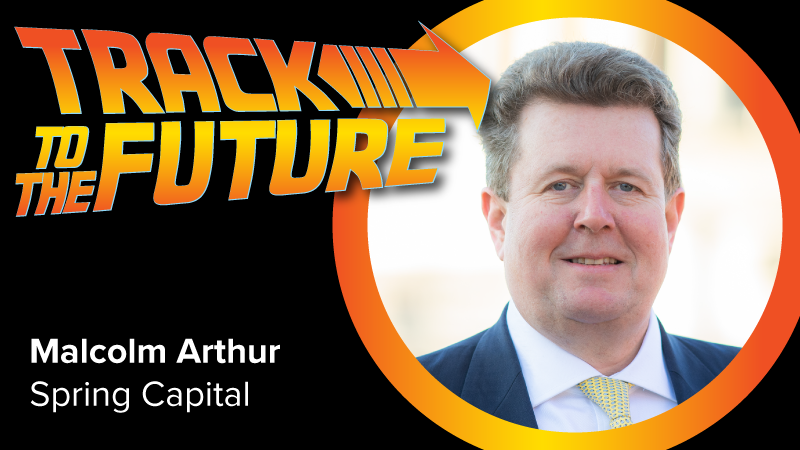

In the latest in our regular series, Track to the Future, fund group distribution bosses share their thinking on asset classes, strategies and working with clients over the next 12 months.
Here, Malcolm Arthur, director and founder, Spring Capital Partners, discusses looking beyond the US, why ESG makes sense and peak passive investing.
Which particular asset classes and strategies do you anticipate your intermediary clients focusing on this year and into next?
There has been a significant shift in sentiment this year from the narrative of US exceptionalism towards a belief that there are other equity markets around the world to invest in. The US will, of course, remain a market worth investing in, but not to the extent it has been.
It feels like one of the policy aims of the Trump administration is to weaken the dollar, so increasing exposure to non-dollar assets would make sense. To this end, I expect more intermediary clients will reduce their US equity exposure and invest more in their unloved home market, the UK, Japan, Europe and Emerging Markets.
Should end investors – and, by association, asset managers – be thinking beyond equity and bond investments? Towards what?
Equities remain the best asset class to invest in for the long term and are the best way to maintain the real value of your wealth. Bonds offer some attractive defensive characteristics, but they will not protect a client’s capital against the ravages of inflation. What else is out there that doesn’t involve either bonds or equities? Private markets are basically equities and bonds – but disguised behind a wall of illiquidity. Gold adds diversification, but it is not a new story. Crypto I am very sceptical about as it doesn’t offer any yield to the investor or have any actual use! Stick with equities for the long term. Uncorrelated absolute return strategies are most certainly worth having as a diversifier.
To what extent do private assets and markets fit into your thinking? What are the current pros and cons for investors?
We think there is a place for private market strategies for sophisticated investors who are well-educated about this space and have an appropriate risk and liquidity profile. Accordingly, we are hearing of more interest from intermediaries who are looking for well-balanced private asset solutions with a view to providing more diversification to the portfolios of the high-net-worth clients. It is essential that any potential investor understands clearly the liquidity restrictions (in normalised and distressed scenarios) and that any provider of these funds is not trying to shoe-horn illiquid investments into an inappropriate vehicle.
Given client and regulatory pressure on charges, how is your business delivering value for money to intermediaries and end-clients?
I think there has been too much focus on charges across the industry. Tracking an index at low cost can work for a while, but good active investment management is not just about whether you outperform an index. It is also about the amount of risk you are taking for investors. All funds show their performance net of all charges, so if your fund can deliver returns ahead of an index with less risk/volatility/downside than the index, then that has to be the best outcome for the end client and the best type of fund to invest in. This is what we would hope our funds can deliver.
How much of your distribution is currently oriented towards climate change, net zero, biodiversity and other segments of sustainable investing? How do you see this approach to investing evolving?
We have no funds that are labelled sustainable, but they all have ESG as part of their investment framework. ESG is sensible investing as it takes account of all the long-term risks a company faces. Companies are an important part of the change that needs to take place in order to make the planet more sustainable, so if investors can apply pressure to those companies, then that is a positive thing.
How are you now balancing face-to-face and virtual distribution? In a similar vein, how are you balancing working from home and in the office?
Nothing beats face-to-face interaction, so our preference would always be for in-person meetings, wherever possible, with clients. We started offering video webinar updates with fund managers before Covid and have slightly increased the frequency of those.
Our team can work from home two days a week, but we have Monday as an anchor day, so we expect everyone to be in the office then, which gets the week off to a good start. We also tend to hold several regular internal meetings on a Monday. Overall, the balance should be in favour of being in the office rather than not.
See also: What does the ‘new’ flexible working look like?
What do you do outside of work?
My favourite thing outside of work is playing golf, but I also enjoy tending to my garden. I find there is a strong metaphor between gardening and life/work – the more you put in, the more you get out of it.
What is the most extraordinary thing you have seen in your life?
I would say the Grand Canyon. I wanted to fly it, but managed to lose my budget the night before in the casinos of Las Vegas! This meant that I hired a car instead, and it took about five hours to drive from Las Vegas to the Grand Canyon. I was regretting gambling the night before and hoping it was going to be worth it. It absolutely lived up to expectations. The most extraordinary natural wonder of the world.
Looking a little further ahead, in what ways do you see the asset management sector evolving over the next few years?
The industry will certainly grow as increasing numbers of people take control of their own pension savings. I hope that active management will come more to the fore and that passive investing has peaked.