





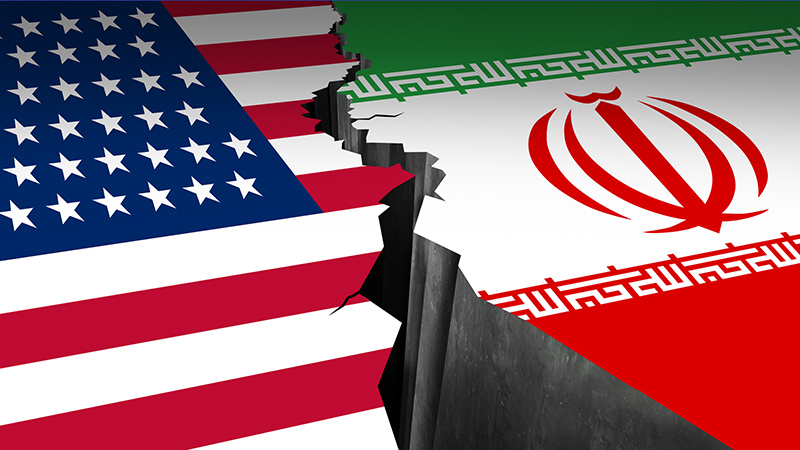

Investors have reacted to the US-Israeli attack on Iran brought war back to the Middle East with most noting the oil price surge of 13% to over $80 a barrel as the week begun.
Anyone banking on a quick, limited outbreak of hostilities over the weekend that would would be calming by the time markets opened will have been left disappointed. Continued escalation appears more likely, with no ceasefire yet in sight.
Serious disruption to global energy supplies is expected, with several large producers facing missile or drone attacks and supply routes through the Strait of Hormuz facing blockages.
The FTSE 100 has fallen 0.7% to 10,883 points. Futures prices indicate a similar dip will occur when the US markets open this afternoon.
The conflict has sent the dollar up as money moved into the safe haven. A pound is now worth $1.33, while a euro is down to $1.13.
Gold has also benefitted form the safe haven trade, putting on another 3% to hit $5,405 per ounce.
Adam Hetts, global head of multi-asset at Janus Henderson Investors, said: “While oil was mainly trading in the $60-$70 range over the last 12 months, prices have already breached $70 and are poised to trend higher with the start of trading on Monday.
“These moves are meaningful but not yet particularly worrisome in the broader scheme of investment implications. A continued increase to $80 would be consistent with the June 2025 conflict, and $90 consistent with April 2024, when global markets were able to largely shrug off the price rises as the conflicts were resolved in relatively short order.
“As a rough proxy for a major conflict, the Russian invasion of Ukraine in early 2022 brought oil prices above $100 for a prolonged period with brief peaks above $120,” Hetts continued. “Oil prices as they stand are pricing in a limited conflict of relatively short duration.”
See also: UK small-cap investment trust considers listing on main market
Emma Wall, chief investment strategist at Hargreaves Lansdown said: “Events in the Middle East over the weekend have added uncertainty, and volatility, to an already choppy market.
“Global equities, buffeted by AI disruption fears and ever-changing tariff policy over recent months, are now digesting the likelihood of significantly higher oil prices, supply chain concerns, and the potential for subsequent higher inflation.
“Investors have reacted by turning ‘risk-off’, buying in to the perceived safe havens of gold, the US dollar and the Swiss franc. Initial equity market reaction was mixed.”
Lindsay James, investment strategist at Quilter, added: “Events in Iran in recent days have brought the vague concept of ‘higher geopolitical risk’ from the back pages of presentations to the forefront of investors’ minds.
“Under Trump, the pattern of behaviour has been that strikes elsewhere have been very short and sharp. This is evidently not the case with this conflict, with a timeframe of four weeks already set out by Donald Trump, against a regime now seen as having nothing to lose, with the military capability to hurt the global economy through disruption to shipping and western interests across the Middle East.
“Markets tend to focus on oil prices, which is pertinent in the case of Iran given the importance of the Straits of Hormuz to energy markets.”
See also: Morningstar: Multi-asset funds still struggle to beat benchmarks